
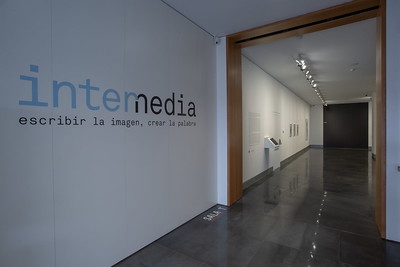
INTERMEDIA. WRITING THE IMAGE, CREATING THE WORD / Various artists
SEP 8 - OCT 23
September 8–October 23, 20
Torre Room
Visual artists:Joan Colom, José Noguero, Juan Uslé, Enrica Bernardelli, Marta María Pérez Bravo, Vicente de Mello, David Moreno, and Mariana Castillo Deball.
Writers:Carlos Bassas, Laura Arnedo, and Valeria List.
Curators: Laura Aizcorbe, Maite Fraile, Victor Acebrón, and Dayneris Brito, graduates of the third class of the Master's Degree in Curatorial Studies.
What is the relationship between visual images and the written word? Is an image a type of narrative? Can text be viewed in the same way as a visual work? How do photography and the written word interact? Do they collaborate, compete, or challenge each other?
Intermedia, which is based on the works donated by Patricia Phelps de Cisneros to the Museum in 2018 and their dialogue with the rest of the pieces that make up the MUN Collection, is the result of the practical work and knowledge acquired during the postgraduate training of the young curators whose Master'sThesishas been chosen from among the various proposals submitted in this 3rd edition.
This proposal takes as its reference some of the photographs taken by Joan Colom in Barcelona's Raval neighborhood, which were the inspiration for Camilo José Cela's book Izas, rabizas y colipoterras. Following this model, photographs by José Noguero, Juan Uslé, Enrica Bernardelli, Marta María Pérez Bravo, Vicente de Mello, David Moreno, and Mariana Castillo Deball have been a source of inspiration for writers Carlos Bassas, Laura Arnedo, and Valeria List, and vice versa. Poems by Arnedo and List have given rise to new works by Pérez Bravo, de Mello, and Noguero.
The result is not a photographic exhibition accompanied by literary works, but rather an exhibition in which both disciplines play an equally important role. Given that the texts on display are inspired by the selected photographs and vice versa, works that are inspired by the text, Intermedia highlights what words and images have in common. It reminds us and emphasizes that reading is a visual act by displaying the text as a visual object and playing with the direction of reading, typography, form, size, and arrangement of words. In turn, it shows that the visual reception of photography is experienced through language. As Didi Huberman stated, "The big mistake is to think that you only look with your eyes. You look with your whole body and, secondly, with language."
|
|
ARTISTS' BIOGRAPHIES
Laura Arnedo
With a degree in Hispanic Philology and Audiovisual Communication from the University of Salamanca, Arnedo (Calahorra, La Rioja, 1982) has published the poetry collections Elogio de la Sed ( Ediciones Eunate, 2014) and Historia de los niños luciérnaga (Editorial Playa de Ákaba, 2017). She has won literary awards and mentions, such as first prize for literary genres at the 2012 Young Art Encounters organized by the Government of Navarra.
Carlos Bassas
Carlos Bassas del Rey (Barcelona, 1974) works as a freelance writer, a job he combines with teaching and screenwriting. In 2007, he won the Plácido Award for Best Crime Screenplay at the 9th Manresa International Crime Film Festival. In 2012, he published his first novel, Aki y el misterio de los cerezos(Aki and the Mystery of the Cherry Trees), and won the City of Carmona International Crime Novel Award for El honor es una mortaja(Honor is a Shroud). Since then, he has continued to write prolifically: Siempre pagan los mismos (2015), winner of the Tormo Negro Award; Justo, winner of the prestigious Hammett Award (2019) given by the Semana Negra de Gijón; Soledad (2019), Cielos de plomo (2021), and Sinántropos (2022), which is his latest novel to date. As a screenwriter, his work on the film Un día más con vida(Another Day of Life) stands out, a production that has won numerous awards, including a Goya and the Best Animated Film Award at the 31st European Film Awards.
Enrica Bernardelli
Born in Italy in 1959, she lives and works in Rio de Janeiro. She is an artist who works with the alteration of the concept of time, reproducibility, and the materiality and immateriality of things. She integrates mobility into photography as a way of questioning the limits of temporality. She has participated in the São Paulo Biennial, the Mercosur Biennial, and various national and international exhibitions.
Mariana Castillo Deball
In her work, Castillo Deball (Mexico City, 1975) proposes a kaleidoscopic vision that explores how collaboration between science, archaeology, and the visual arts can describe the world. Her installations, performances, sculptures, and editorial projects arise from the recombination of diverse languages and explore the role of objects in understanding our history and identity. She obtained a degree in Fine Arts from the National Autonomous University of Mexico in 1997 and in 2003 completed a postgraduate program at the Jan van Eyck Academie in the Netherlands. He has received the following awards: Prix de Rome (2004); Zurich Art Prize (2012); Henry Moore Institute Fellowship (2012) and Preis der Nationalgalerie für junge Kunst (2013). He currently lives and works in Berlin.
Camilo José Cela
Camilo José Cela (Galicia, 1916 - Madrid, 2002) was a prolific Spanish writer who won the Nobel Prize in Literature, the Miguel de Cervantes Prize, and the Princess of Asturias Award for Literature, among others. Since his first novel, La Familia de Pascual Duarte, which marked a milestone in post-war Spanish fiction, his output has been extensive and uninterrupted.
Joan Colom
Winner of the National Photography Award and the Gold Medal for Cultural Merit awarded by Barcelona City Council, Colom (Barcelona, 1921-2017) belonged to the first post-war generation of photographers. He portrays the fleeting, an uncompromising realism that he finds in the streets.
Vicente de Mello
An artist and curator born in Brazil (1967), he lives and works in Rio de Janeiro. With a degree in Social Communication and Art History and Architecture, from 1989 to 1998, he worked in the Photography Department of the Museum of Modern Art in Rio de Janeiro. Since 1992, he has been developing his photographic research through different series. He has participated in exhibitions in his native country and in others such as Belgium and France.
Valeria List
Born in the Mexican city of Puebla in 1990, she writes and translates poetry. Her first book, La vida abierta, received the UNAM Young Poetry Prize in 2019. In 2021, she published La plaquette Calgary with Sombrario Ediciones and Adie with the digital poetry publisher Matrerita. She has a degree in Hispanic Literature and a master's degree in Spanish Literature from the National Autonomous University of Mexico. She works in the Publications Department of the Institute of Library Science Research at this academic center. In 2019, she received a scholarship from Elipsis, the British Council's writing program, and from the T.S. Eliot Summer School at the University of London. She is currently enjoying a poetry scholarship in the Young Creators program of the National Fund for Culture and the Arts of Mexico.
David Moreno
Moreno (United States, 1957) lives and works in New York. His work is multidisciplinary, playing in different artistic fields such as drawing, photography, sound works, and video creations. He has participated in numerous group and solo exhibitions. In 2008, he was awarded the American Academy Invitational Exhibition of Visual Arts, American Academy of Arts and Letters in New York.
José Noguero
Born in Basbastro (Huesca) in 1969, Noguero is one of the most brilliant artists of his generation. His study and research into the limits of sculpture have led him to explore other means of expression, such as photography, painting, and video art. Since 1999, he has lived and worked in Berlin. Throughout his career, the artist has participated in numerous solo and group exhibitions in Spain and abroad.
Marta María Pérez Bravo
The work of Marta María Pérez Bravo (Havana, 1959) explores black-and-white photography based on dreams and mythologies, drawing on popular Cuban cults and the religious practices and symbols that surround them. She studied painting at the National Academy of Fine Arts in 1979 and at the Higher Institute of Art in 1984. Since 1995, she has lived and worked in Mexico. Her work has had an international presence, both in biennials and in collections and exhibitions at museums such as MoMA (USA), the Reina Sofía Museum (Spain), the Palacio de Bellas Artes in Mexico (Mexico), and the San Francisco Museum of Modern Art (USA), among others.
Juan Uslé
Uslé (Cantabria, 1973) began his studies in Fine Arts at the San Carlos School of Fine Arts in Valencia. During this period, he alternated his passion for painting with photography, understanding the latter as something open, experimental, and subjective. When he returned to Santander, he focused more definitively on painting. Since 1986, he has been based in New York. He is recognized as one of the most important artists of his generation and a leading figure in the international art scene. In 2002, he received the National Prize for Plastic Arts. He has participated in Documenta 9 in Kassel, the 51st Venice Biennale, and solo exhibitions at the Kunstmuseum in Bonn, the Irish Museum of Modern Art in Dublin, the Reina Sofía Museum in Madrid, the MACBA in Barcelona, and the IVAM in Valencia.
With the support of the Pablo Palazuelo Foundation

RELATED ACTIVITIES
September 8 / 7:00 p.m. ·The artist is on campus. Masterclass with Laura Arnedo
September 16 / 12:00 p.m. ·Workshop with writer Carlos Bassas. Narrating the image: how to construct a story through a photograph
September 30 / 12:00 p.m. ·Workshop with writer Carlos Bassas. Two intangible elements in literary creativity: perspective and style.
OCT 15 / 10:30 AM ·Children's workshop with Laura Arnedo. The magic glasses of poetry: another way of seeing and creating
Access the virtual tour of this exhibition
Header image: Isolated light. Bath. Juan Uslé
Date
September 8, 2022
Time
8:00 p.m.