
Collection: Policies
PRESERVATION OF THE COLLECTION
The conservation plan follows general guidelines for the entire work, including controlled, monitored, and stable temperature and humidity conditions, smoke detection, fire prevention measures, and weekly inspections of the exhibited work by the museum's conservation team.
These measures are accompanied by a 24-hour physical and video surveillance plan.
Paintings and sculptures are described morphologically after being inspected one by one, which allows a report on the condition of the work to be drawn up when it enters the collection. The works are recorded in the collection database, which records the state of conservation of each piece.
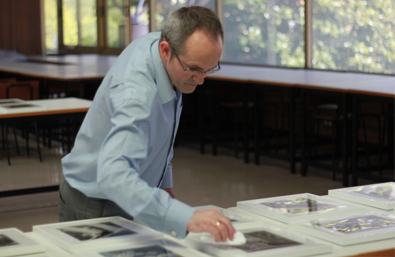
In the case of photographs, depending on the characteristics of the process, type of paper, type of emulsion, and state of preservation, the items undergo physical cleaning and are stored in individual Mylar envelopes. Each photograph is assigned a registration number andstored in fire-enameled trays or acid-free containers.
When cataloguing the pieces, their condition is noted in a specific field for reference purposes (good, fair, or poor). When a work is loaned for an exhibition, a complete condition report is prepared before it leaves the museum, noting the condition of the work, and high-resolution photographs are taken to document its condition. We currently have condition reports for 805 works.
Storage conditions are stable and optimal for the stored items.
The display conditions are between 20 and 22 °C and 45-50% RH. The museum is lit with ERCO LEDs, which are dimmable and UV-free. The power measured in LUX varies from 18-25 lux, which is used to illuminate calotypes and salted paper prints, to 100 lux for carbon emulsions, 125 lux for prints on cotton with mineral pigments, and 150 lux for oil paintings. Sculptures vary from 125 lux to 250 lux, depending on the materials.
The Museum is developing a Preventive Conservation plan that covers not only the conservation of the collection but also protocols for action in certain situations.
This plan is managed by the Curatorial Department but is developed in collaboration with the rest of the Museum's departments and includes training for gallery staff and security personnel on how to respond to different situations.
CRITERIA AND HISTORICAL EVOLUTION OF COLLECTION GROWTH
This photography collection is a living collection, still growing.
The strategic lines of development for the collection focus, on the one hand, on completing research into the development of photographic technique from its origins to the present day; and, on the other, on promoting contemporary art and creation.
1. Through the program called "Building Bridges," inherited from the Photography Fund and launched in 2002, visual artists are invited to develop their own projects with the support of the collection and exhibition department. The project is included in the editorial line of the same name.
Since 2016, performing artists have also had access to an artist residency program inspired by the collection and included in the "Cuadernos de Creación" (Creation Notebooks) collection.
The purpose of both programs is to create contemporary works based on historical pieces preserved in the Museum. Various contemporary artists of national and international renown have been invited to carry out a personal reflection, a project of their own in dialogue with key pieces of universal photography contained in the Museum's collection.
International photographers such as Roland Fischer, Lynne Cohen, Gabriele Basilico, and Luis González Palma have participated in this program, as well as Spanish photographers such as Manuel Brazuelo,Jorge Ribalta, María Bleda and José María Rosa, Joan Fontcuberta, and Javier Vallhonrat, and Navarran photographers such as Ángel Fuentes, Carlos Cánovas, and Carlos Irijalba. A total of 35 visual artists and 13 performing artists have participated in these programs to date, enriching the museum's collection.
2. Alongside these programs, we find the traditional ways of adding pieces to the collection by acquiring works on the market, either directly from artists or from galleries or auction houses. The Museum does not have a fixed annual budget for purchasing works, but rather decides on its acquisitions based on the collection's development strategy.
3. The Museum carries out crowdfunding campaigns that enable the acquisition of new pieces.
4. The rest of the artistic additions come to the Museum through donations from people linked to the arts who wish to contribute to the research, teaching, and dissemination work carried out by the institution.
LOAN OF COLLECTIONS
The University of Navarra Museum is an open museum that maintains constant contact with other national and international art centers.
Since its opening in 2015,it has collaborated by lending its collections to exhibition projects produced by other museums and institutions, including : IVAM, ARTIUM, Museo Esteban Vicente, Museo Bellas Artes de Bilbao, MACBA, CAAM, MNCARS, MNAC, Fondation Cartier pour l'Art Contemporain, Maison de Patrimoine, Hôtel de Sully, Instituto Cervantes, Saint Louis Art Museum, Museo Balenciaga, and The Israel Museum.
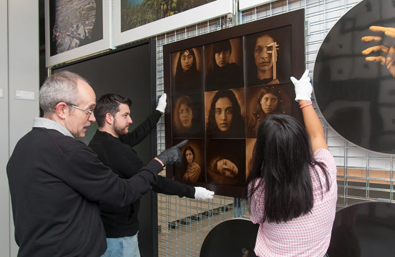
The requesting institution is asked to provide a facility report and is checked to ensure that it meets the environmental, physical, and security criteria for exhibiting the requested items. If it does not meet these criteria, the loan is denied. If the items requested for exhibition are photographs, facsimile reproductions are offered. These reproductions are made under the supervision of the team responsible for the collection and are returned to the Museum after the exhibition.
In turn, the Museum has its own facility report that is provided to institutions that request loans of works.
Loans for construction projects made in each fiscal year are included in the corresponding annual report.
A complete list of loans can be found atthe bottomof the exhibitions page. The team works to update this record in real time via the website providing access to the entire collection: coleccionmun.unav.edu, in the Collections and Loans section.
YEAR 2014
Two works by José Ortiz Echagüe for the exhibition "Dries Van Noten." Musée des Arts Décoratifs, Paris. February 26 to August 31, 2014.
Nine works by José Ortiz Echagüe for the exhibition "La colonia apócrifa" (The Apocryphal Colony). Museum of Contemporary Art of Castile and León. June 20, 2014, to January 5, 2015.
YEAR 2015
10 works by Antonio Arissa for the exhibition “Arissa. L’ombra i el fotògraf, 1922-1936” (Arissa. The Shadow and the Photographer, 1922-1936). Centre de Cultura Contemporània de Barcelona. October 15, 2014, to April 30, 2015.
1 work by José Ortiz Echagüe for the exhibition "At the forefront of art. Ricardo de Orueta 1868-1939." Acción Cultural Española. From September 16 to December 8, 2014, at the National Sculpture Museum, Valladolid / From December 18 to March 8, 2015, at the MUPAN galleries, Malaga City Hall. From March to June 2015, at the Estudiantes residence in Madrid.
Two works by José Ortiz Echagüe for the exhibition "Movements and Sequences." Picasso Museum, Malaga. February 2 to May 17, 2015.
22 works by José Ortiz Echagüe for the exhibition "Bringing shores closer together. Expectation and memory." Apeadero Hall, Reales Alcázares, Seville. May 29, 2015, to July 20, 2015.
9 works by Pere Formiguera for the exhibition “Pere Formiguera. Ars Photographica.” Center for Contemporary Art and Culture. San Cugat del Vallès City Council. March 4 to June 29, 2015.
YEAR 2016
1 work by Gabriel Casas for the exhibition “Gabriel Casas. Photography, Information, and Modernity in Barcelona 1929–1939.” National Art Museum of Catalonia. April 22 to August 30, 2015. Caixaforum Girona from September 22, 2015, to January 17, 2016. Caixaforum Tarragona from February 9 to May 29, 2016.
Nine works by Luis González Palma and two by André Disderi for the exhibition "Luis González Palma. Constellations of the Intangible." CGAC, November 12, 2015, to March 2016.
16 works by Javier Vallhonrat for the exhibition "Interactions." CGAC. October 30, 2015, to February 28, 2016.
33 works (Vigier, Beaucorps, Delaunay; 28 facsimiles and 5 originals) for the exhibition "Seville through photography." University of Seville. March 10 to April 22, 2016.
Eight works (Battistuzzi, Frith, Franck, anonymous) for the exhibition “Barcelona. The metropolis in the age of photography. 1860–2004.” March 22 to June 26, 2016.
1 work by William Stirling for the exhibition "Copied by the Sun." Prado National Museum. May 18 to September 4, 2016.
24 works by José Ortiz Echagüe for the exhibition "Carbon and Velvet. Perspectives on the Traditional Costumes of Ortiz Echagüe and Balenciaga," at the Cristóbal Balenciaga Museum in Getaria. October 6, 2016, to May 9, 2017.
1 sketchbook, with 63 works, for the exhibition "Una modernidad singular" (A Singular Modernity), at the San Telmo Museum in San Sebastián. November 4, 2016, to February 26, 2017.
Seven works by José Ortiz Echagüe for the permanent exhibition at the Reina Sofía National Art Museum (MNCARS) for a period of five years.
2017-18 academic year
Works by José Ortiz-Echagüe for the exhibition Region (The Stories). Changing Landscape and Water Policies at the Museum of Contemporary Art of Castilla y León (MUSAC).
Works by Ortiz Echagüe for the exhibition Provincia 53. Art, Territory, and Decolonization of the Sahara at the Museum of Contemporary Art of Castilla y León (MUSAC) and the Nature Center (CDAN) of the Beulas Foundation (Huesca).
* The 2018-19 academic year ends on August 31, 2019.