
Building Bridges is a curatorial project promoted by the University of Navarra Museum since 2002. The Museum's collection traces the history of photography in Spain, from its origins (the first photograph dates back to 1848) to the present day, focusing on photography from a documentary perspective and its relationship and influence on the real and the imaginary. As a project, Building Bridges fosters dialogue between contemporary photographers and artists and the Museum's collection.
The program reflects the MUN's artistic project: a museum that conducts research with artists and accompanies them in their creative process. The experience serves as the methodological basis for launching, in 2016, a program of Artistic Creation Residencies in the field of performing arts and music.
Fernando Pagola knows the project well, having been involved with the museum since its inception. This close connection and deep knowledge are masterfully reflected in the creative project and its meticulous staging.
The three "movements" of this Triple Concerto gave rise to various conferences and workshops, as well as a dance performance by choreographer and dancer Jon Maya, who presented the creation Tres Movimientos (Three Movements) after talking with Pagola and addressing common themes and interests from their different perspectives. This work is a good example of the transdisciplinary nature and intent of the Museum's projects.
To learn more
Create your user account on the Museum's exclusive content platform to access the artist's Masterclass prior to the opening.
The catalog, collectible, and exhibition brochure are available at the museum reception desk.
The Waiting Game III concludes the artist's trilogy on "waiting," in this case the waiting of a dog guarding a property. The previous volumes were devoted to roadside prostitution in eastern Spain and fishing in irrigation ditches and reservoirs. This award-winning project by the RV publishing house concludes with Waiting Game III, published by the same publisher with the support of the University of Navarra Museum.
Large-format photographs confront visitors with the breadth of the artist's vision, the light of the Mediterranean, and a refined photographic technique that is the artist's hallmark.
To learn more
Access the virtual tour of the exhibition
Create your username on the Museum's exclusive content platform to access theMasterclass with the artist prior to the exhibition opening.
The exhibition catalog, as well as the collectible and exhibition guide, are available at the museum reception desk.
José Luis Alexanco tackles this creative project in collaboration with the museum's artistic directors, Valentín Vallhonrat and Rafael Levenfeld, and proposes to create his "Tenth Room." The artist's death while working on this "Tenth Room" left the piece partly unfinished, and only nine pieces make up the artist's last Tenth Room. Hence the name of the exhibition and the project.
At the artist's express wish, the exhibition is planned for 2022, the 50th anniversary of the "Encuentros de Pamplona del 72" (Pamplona Encounters of '72), which he helped organize as part of the Alea Collective and thanks to funding from the Huarte family.
During the exhibition period, various conferences were held on the work and figure of José Luis Alexanco, as well as workshops for children and families. The opening coincided with the program organized by the Government of Navarra around the "Encuentros de Pamplona 72-22" (Pamplona Encounters 72-22).
To learn more
Access the virtual tour of the exhibition
Create your user account on the Museum's exclusive content platformto access:
- The masterclass prior to the exhibition opening by Sergi Aguilar
- Alfonso de la Torre's lecture on Percursum.
- Capi Corrales' lecture "How to do things with... mathematics"
Purchase the exhibition catalog
The exhibition brochure and collection catalog are available at the museum reception desk.
The creative project The Edge is the result of Álvaro Laiz's work between 2016 and 2022. The artist retraced the steps of the first settlers of America who arrived thousands of years ago from the Bering Strait.
Time, space, population genetics, and the culture of peoples come together in an ambitious project that immerses visitors in an exciting visual journey that brings together the artist's major concerns.
Captivated by ancient photographic development techniques and portraits by the pioneers of this art, Laiz weaves together his works and the museum's established itinerary to create an ambitious journey that ends with this exhibition in Tierra del Fuego but will continue to the southernmost tip of the continent.
The project was supported by National Geographic Fellows and the Burroughs Foundation and was accompanied by an initiative that sought to measure its sustainability both as an artistic project and as an exhibition project, an initiative called Beyond The Edge. The Museum supported the artist's initiative through a collaboration with the School of Architecture, measuring the actual consumption and energy performance of its facilities in order to design a plan to optimize its environmental impact within the University's 2025 Strategy. This work was presented at the ICOM 2022 Congress held in Prague.
A masterclass by the artist, an activity linked to the New European Bauhaus Festival, and several children's activities were scheduled around the exhibition.
To learn more:
Create your user account and access the Museum's exclusive content platformto view:
- Alvaro Laiz's masterclass prior to the exhibition opening.
- The conference "How to do things with our ancestors"
Exhibition website
Virtual tour
Purchase the exhibition photo book
The exhibition brochure and collection catalog are available at the museum reception desk.
Co-produced with the Galician Center for Contemporary Art, this exhibition introduces us to Hamish Fulton's creative project. The line of work of this artist-walker followed the reverse route of the Camino de Santiago: starting in Hendaye and ending in Santiago.
The exhibition showcased the artist's evolution as well as his current concerns regarding sustainability, the use of technology, and the need for direct experience of nature.
During the presentation of the exhibition, the artist explained the key elements of his work in a masterclass, the text of which can be read at this link, and shared two artistic actions with students from the Campus on the esplanade of the Faculty of Communication (Walking in every direction) and with the citizens of Pamplona in a central square in the city (Slowalk).
Various workshops for children and schools were held in connection with the project.
To learn more:
Create your user account and access the Museum's exclusive content platform, where you will find the Masterclass with artistHamish Fulton prior to the opening.
Access to the exhibition website
Access to the virtual tour
Purchase the exhibition catalog
The exhibition brochure and collection catalog are available at the museum reception desk.
The physical and chemical processes and the forms they take are the phenomena that underpin this creative project by Carlos Irijalba. On the one hand, the artist explores the limits of the collection in its physical and chemical aspects, as well as the image that is not constructed optically, but through other diverse processes, from medical laboratories to scanning electron microscopes. Waynside deals, in the artist's own words, "with the transversal relationships between parallel dynamics. The sumptuous forms of corded lava behave in the same way as the meander of a river or the design of the circulatory system that irrigates our brain as we read this text or identify that image. A material that passes through a liquid state before solidifying and subsequently conducting a gas, as opposed to the sediments of a delta rearranging themselves."
Aesthetics is a key common thread, as it is one of nature's oldest and most effective strategies.
This research, which has benefited from the collaboration of professionals from various scientific disciplines, takes an approach to crystallization that gives substance to something that initially has none, from pure matter or abstraction to the immaterial flows that generate reality or give rise to our own experience. Matter takes on different forms at different physical or temporal scales and requires both dimensions to occur and transcend thanks to the relationship between them.
To learn more
The Aleatoris Vulgaris series was exhibited at the Museum as part of the Fantastic Pseudologyexhibition . Theseries, inspired by the Museum's collection, challenges the very logic of the archive. While an archive is constructed with the intention of organizing and grouping existing elements, giving them an order to facilitate their location, the project plays with the creation of random algorithms using the most disparate means of selection and registration of the various pieces cataloged within the Museum's collection.
Cristina De Middel's work explores the ambiguous relationship between photography and truth. Combining documentary and conceptual approaches, she plays with the reconstruction of archetypes and stereotypes that help blur the line between reality and fiction, suggesting that we take a critical look at the way reality is presented to us. On this occasion, she invites us to explore the impossibility of randomness.
To learn more:
Access to the exhibition website
Access the virtual tour of the exhibition Fantastic Pseudology, which includes this project.
The exhibition brochure and collection catalog are available at the museum reception desk.
The Japanese artist, based in London, carried out a creative project focusing on memory and forgetting, our relationship with both concepts, and how this affects our lives.
His exhibition, which included pieces and installations with moving images, featured a masterclass with the artist, various activities with the university's Faculty of Medicine and School of Nursing, and a Japanese film series focusing on everyday life and the construction of family memory.
The museum's film series included a screening of Spanish classics, including El perro andaluz, which the artist cites as one of his reference works. The screening featured a Japanese jazz duo and the artist himself, who performed live music.
The artist's Tender Puentes project was included in a special volume of the collection entitled Figment.
To learn more:
Project website
Masterclass with the artist
The artist talks to us about the exhibition and the project.
Dialogues with the work of Hiraki Sawa
Silent film classics with Hiraki Sawa
Virtual tour of the exhibition
Purchase the exhibition catalog
The exhibition brochure and collection catalog are available at the museum reception desk.
The artist explains the exhibition that brings together the creative project and its layout in the museum's galleries:
For his creative project, photographer Aitor Ortiz has chosen works from the Museum's Collection that belong to the period of the industrial revolution at the Altos Hornos de Bilbao steelworks and those from José Martínez Sánchez's album of bridges. Both accompany a process of introspection, of looking back at the past, as they are linked to his memory and his profession, respectively.
In the exhibition that resulted from the creative project, Aitor Ortiz showed, among other things, a series in which he broke down architectural space and took it to the frontier of sculpture, inviting visitors to explore the tension between the limitations of photography and the spatial perception it generates.
Human beings are never present in Aitor Ortiz's work, perhaps because of the "uninhabitability" of the spaces he constructs or because of the prominence of emptiness, which is charged with poetry. In his work, poetics is a language of its own, capable of containing the physical, mythical, emotional, and sensory elements that belong, without naming it, to the place where his work arises and where it converges with his life.
To learn more
Masterclass by the artist at the exhibition opening
Access the virtual tour of the exhibition
The exhibition brochure and collection catalog are available at the museum reception desk.
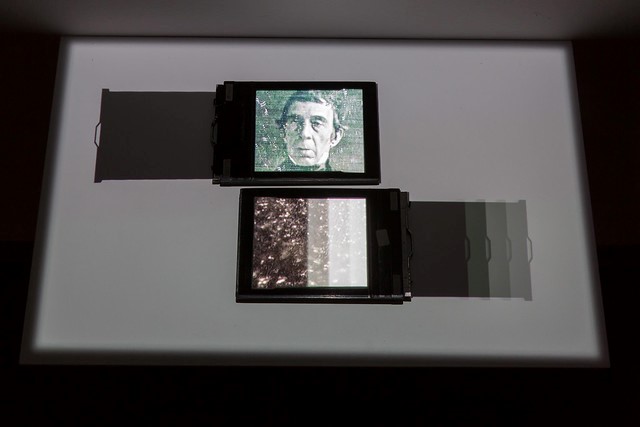
The series is inspired by daguerreotypes and explores the life and death of technology, along with our emotional attachment to many of these technological devices that were once true miracles of engineering. The artist rescues them, as a tribute, and attempts to show the more human side of technology. To do this, video animations are projected onto their surfaces, seemingly bringing them back to the present.
DANIEL CANOGAR
Madrid, 1964
He lives and works in Madrid. He studied Image Sciences at the Complutense University of Madrid and obtained a master's degree in Art with a specialization in Photography at New York University/International Center for Photography, New York. Since his early days, he has worked combining photographs and light projections that refer to the human body to analyze behavior through visible fragments such as the face and hands or by exposing its internal construction based on images of cells, always using neutral supports such as methacrylate, fiber optics, or light projections.
Daniel Canogar's artistic projects and research explore the relationship between humans and technology, reflecting on how it conditions the way we relate to the world and our own bodies.
The artist has a direct and close relationship with the University of Navarra Museum and collaborates with the Master's Degree in Curatorial Studies, sharing his vision with future curators and inviting them to "put themselves in his shoes."
To learn more
Press site
Artist masterclass site April 20, 2019
Access the project publication
Access the virtual tour of the exhibition
The collectible and exhibition brochure for the Sikka Ingentium exhibition are available at the museum reception desk.
Disparates: Photography and Public Works was on display at the University of Navarra Museum between October 25, 2017, and April 1, 2018. The collection of photographs Public Works, which consists of images of civil engineering projects in 19th-century Spain, belongs to the University of Navarra Museum (MUN) and served as the inspiration for the artist's project.
Juan Ugalde approaches these historical, old photographs in a very personal and contemporary way, mixing "local, familiar" elements in each one: physical reality versus virtual reality.
Ugalde contrasts old images, "the beginning of what has come after," with drawings that somehow anticipate what is to come, added elements that are not exactly "modern," but are somehow also outdated, suggesting that there is not much promise for that future. Ugalde describes "Disparate"—which refers to Goya's Disparates—as "that generated by progress (...) by the development of human beings over the last century and a half."
Juan Ugalde
A painter and photographer, in recent years he has been using the collage technique in his works. He has been working since the 1980s, when he added comic book elements to paintings of delirious realism and marginalization. His work can be found in museums such as the Reina Sofía National Museum of Contemporary Art in Madrid, the Patio Herreriano in Valladolid, the La Caixa and ICO Foundations, and the Botín and Bank of Spain Collections, among others.
To learn more
Virtual tour of the exhibition
The exhibition brochure and collection catalog are available at the museum reception desk.
Javier Viver
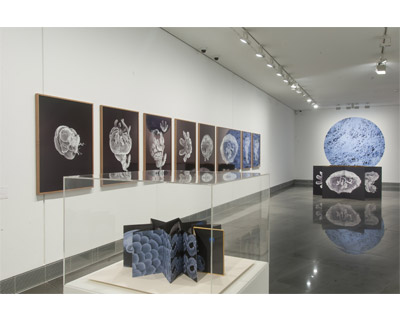
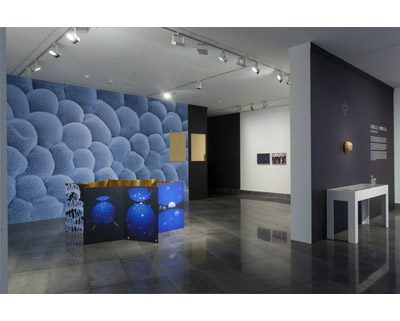
This project by Javier Viver focuses on the existence of a peculiar creature:Aurelia aurita, a type of jellyfish that has the ability to regenerate itself indefinitely. Viver seeks to photographically document the life cycle of this species, guided by a scientific and metaphysical interest in a phenomenon found in nature that leads to a reflection on the possibility of immortality. The exhibition displays the photographic series created by the artist, accompanied by a photobook designed by the author.
To learn more
Access the virtual tour of the exhibition
Purchase the exhibition catalog
The exhibition brochure and collection catalog are available at the museum reception desk.
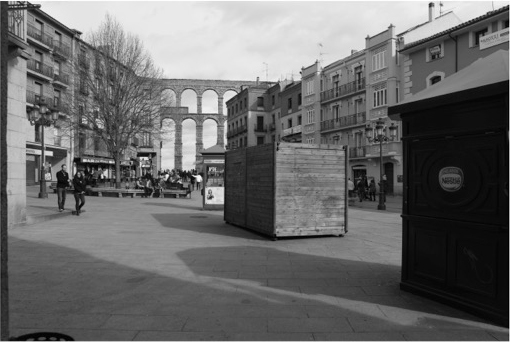
MANOLO LAGUILLO
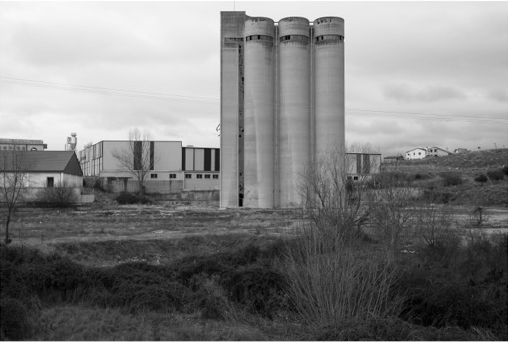
The author's project consists of photographing several Spanish provincial capitals that have very particular physical characteristics as a result of their recent histories. They do not belong to the rich periphery of the country, nor to the center, and their role, with little growth over the last century, places them in the background. The transition to the countryside, an environment that these cities possess, is still quite similar to that of almost all cities in our country a hundred years ago, when industrialization was practically non-existent. In these cities, there is still no continuity between the dense urban center and the countryside, as industrial parks and housing developments located outside the city walls have not yet completely surrounded them. This physical characteristic is related to the size of these towns, which is small enough that it is almost possible to take in the whole city at a glance without having to resort to an airplane.
Laguillo aims for the photographs in this project to continue to represent reality in as much detail as possible, as he has always sought to do, with the richest possible tonal range, because he wants to achieve the most perfect degree of clarity and purity, of illusion in short, that the medium of photography is capable of providing.
Las Provincias was exhibited in its entirety for the first time at the exhibition Projects: Four Decades, from October 27, 2021, to March 23, 2022. A comprehensive program of activities was developed around the exhibition to understand the impact of this work and the issues it addresses.
The exhibition and the program surrounding it were supported by CORREOS DE ESPAÑA.
To learn more
Artist's explanation of the exhibition Projects: Four Decades
Available at the museum reception desk: the collectible exhibition brochure and exhibition guide for Projects: Four Decades.
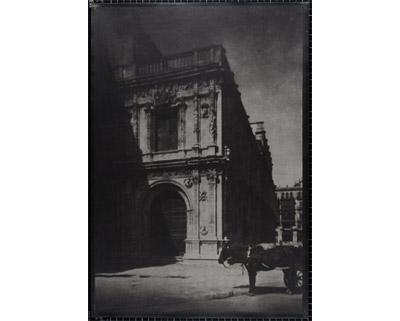
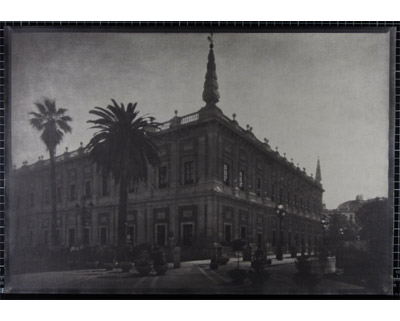
MANUEL BRAZUELO
His project for Tender Puentes is made with pinhole cameras and his positives are produced using the gum bichromate technique.
His preference for using this camera was due to the freedom it gave him to decide on the format of the negative. In addition, the lines were always parallel to the axes of the negative, and the photographed scene was in focus at all points.
The transfer of negatives to a pigmentary medium originated for Brazuelo in the exhibition Imágenes de la Arcadia (Images of Arcadia, 1984), curated by Joan Fontcuberta at the National Library in Madrid. The impact of seeing virtually all the pigment processes and their different possibilities for displaying an image on paper brought together in one place led him to adopt these methods. Brazuelo uses gum bichromate not as a result he wants to show in itself, but for the iconic consequence produced when combined with the pinhole. The project presented by the author is divided into two parts: Granada and Seville.
The images of Granada are the result of two years of careful observation of the Alhambra, until he decided to approach his work as if it were a fortress. He conceived his work as a series of journeys starting from his own home to the walls surrounding it on the mountain, without crossing them, attempting to reveal the essence of its interior.
His Seville series is based on maps of the city, where he marks the spots where 19th-century travelers took photographs that have become icons of the city for him, executing his images in a way that incorporates perspectives that do not hide what the modern city offered him.
To learn more
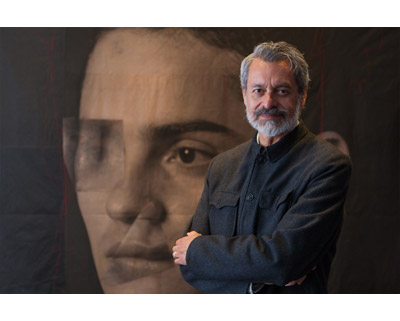
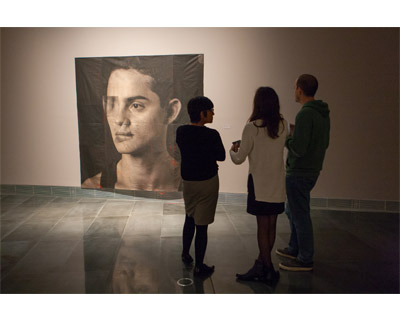
LUIS GONZÁLEZ PALMA
Through his work,González Palma experiments with the technical and formal solutions of photography,redefining the boundaries between photography and painting, influenced by his training as an architect and his approach to religious painting, which also sparked an interest in abstraction.
In his work, we can see a series ofrecurring themes, among whichthe importance of beauty, reflections on power, and the concept of image and its perception by others stand out. He proposes areflection on the gaze, a reflection of how we see others and how we see ourselves, linked to the awareness of not being seen and the unease that this causes.
Through his work, we see anevolution from concepts linked to identity and memory to the coexistence of abstraction and figuration, becausefor him both have the same purpose:to understand and give meaning to the image, againin relation to the gaze and the capture not only of the individual, but of the human condition.And this idea frames the importance that portraiture has in his work, often in relation to formal solutions and the viewer, who contemplates it without intermediaries.
To learn more:
PIERRE GONNORD
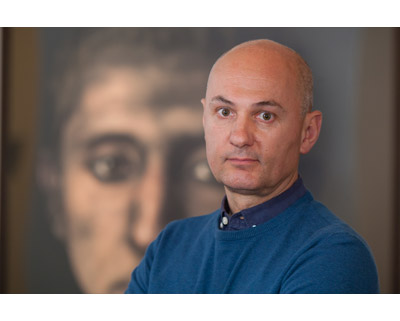
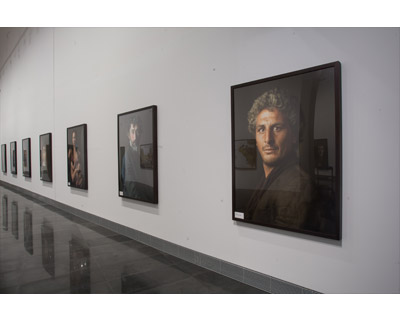
The origin ofPierre Gonnord's (Cholet, 1963) workDe Laboris lies in theMuseum's commissionfor him to participatein the Tender Puentes series with aproject based on the Museum's photographic collections. In the Museum's photographic collections,Gonnord discoveredportraits by photographers of the past, such as Napper and Laurent, but above all Tenison.
Gonnord's gaze focuses on characters who have been disinherited by society, on whom the weight of lineage and tradition falls. These anonymous faces awaken our emotions and become transcendent, timeless, and eternal. Gonnord's work inDe Laborisis based on the theme of portraiture, which he himself describes assilent interpellations that soberly narrate unique stories through simple language. The photographer captures these figures and restores their dignity, photographing them in close-up, full-length or bust, gazing into the infinite, oblivious to the lens, the photographer, or the audience that contemplates them and whose presence makes them real and eternal.
His photographs reflect empathy with the problems and life experiences of those portrayed. To achieve this,Gonnord gets involved with these individuals and groups, living with them,getting to know them and understanding their essence, discarding what does not interest him and choosing those who will become the subjects of his portraits,seeking to capture their charisma.
In Los Gitanos de La Raya , he focuses on a racial group that, even though they still live among us today, symbolize in the collective imagination apeople exiledfor centuries,struggling for survival and preservation in the faceof globalization. This is anomadic group that lives between Spain and Portugal,and they reflect the mixed heritage of the different races that populated the Iberian Peninsula alongside that of the Gypsy people.
While in The Miners, it reflects a world already in decline, of heroes forged in the early days of the labor and union movement. Gonnord portraysthe miners of the Asturian-Leonese basin, where, alongside workers native to the region and heirs to long dynasties linked to the mine, immigrants from different European mining basins now live, who are alsoheirs to an ancestral tradition linked to a hard and difficult working world,but one that is young and vital,composed mostly of men.
To learn more
Access the virtual tour of the exhibition
The artist's creative process
Mathaussen's suitcase
The exhibition brochure and collection catalog are available at the museum reception desk.
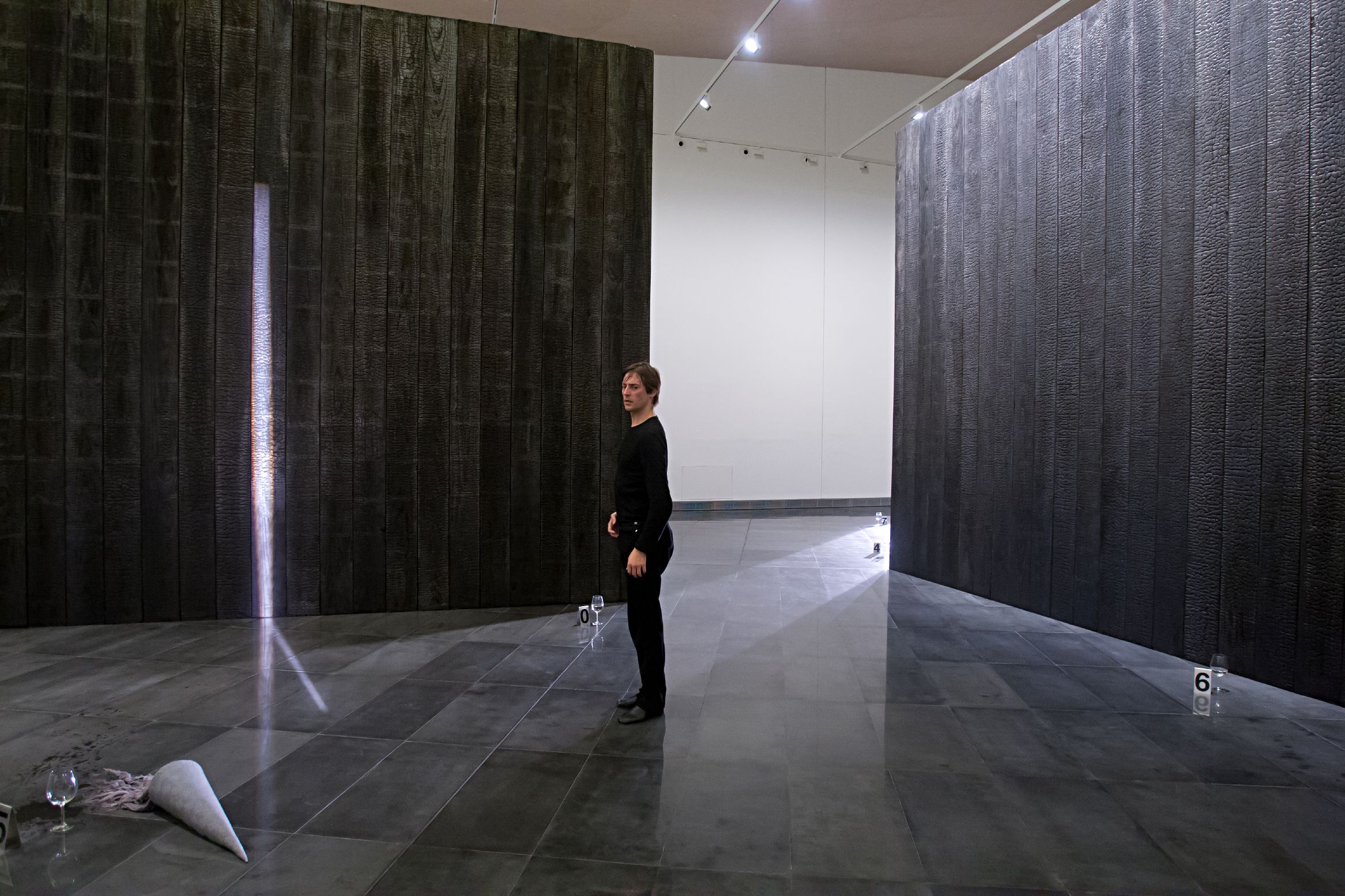
One of the inaugural exhibitions at the University of Navarra Museum and the first of the Building Bridges projects that visitors were able to view in the galleries of Rafael Moneo's newly inaugurated building. It was also one of the first occasions on which Javier Martín's dance and the work of a visual artist were brought into dialogue through performances in the galleries, one of the hallmarks of the Museum.
A striking project byÍñigo Manglano-Ovalle(Madrid, 1961), specifically designed for the La Caixa room on the ground floor of the MUN. In this work, the Madrid-born artist, now based in Chicago,tacklescurrentconcerns fromapoeticperspective.
The project, rooted in German philosopher Martin Heidegger's essay Bauen, Denken, Wohnen(Building, Thinking, Dwelling), took shape in two 5×5-meter cubes clad in charred radiata pine wood. The wood was charred using a Japanese architectural technique known asShou Sugi-Ban, which dates back more than a thousand years. This process creates a charred, black and silver exterior that is naturally resistant to weathering and decay.
The two cubes or cabins were accompanied by large-scale images taken in the Hayedo de Quinto Real, in northern Navarra, with the same texture as the charcoal itself. The printing process is also derived from charcoal, the central material in all of his work.
The artist confronts us with issues such as deforestation, nature, and the ecological impact of contemporary culture, offering an implicit critique of humanity's relationship with nature through the image of coal.
The cubes are both sculpture and architectural intervention in space, and they engage visitors in a game of concealment, since at first glance they will only perceive a large cube. It is necessary to walk through the room, accept the invitation to action and experience the space and the place in order to arrive at a revelation that does not respond to the exterior space, but rather leads to an interior illumination.
To learn more:
https://youtu.be/aSB34LdZmQw
Purchase the project book and exhibition catalog
The exhibition brochure and collection catalog are available at the museum reception desk.
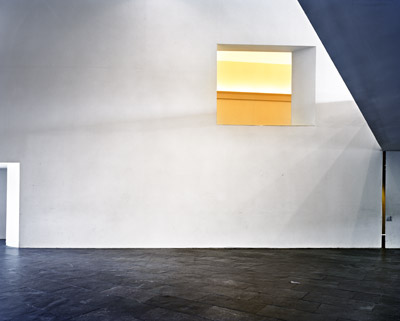
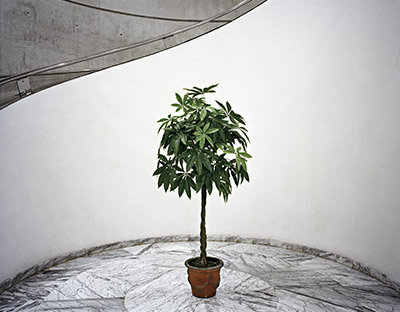
LYNNE COHEN. 'SOULMATES'
The author has focused her project on various public and institutional buildings in the city of Pamplona and on the interiors of several spas in the region. Her gaze has always been attentive to interior spaces with functions related to waiting, transit, and access. These are domestic spaces located inside public buildings, universities, hospitals, or offices.
Her way of observing reality bears a certain resemblance to early 19th-century photography in its treatment of the in-between and its attention to everything that, due to its insignificance, is taken for granted or excluded from a certain official life, although she has developed a poetics of objects closely linked to a description of situations in the absence of events. His gaze is far from any idea of memory or nostalgia for the passing of time, and he emphasizes the fragility of the present.
In the project at hand, there is a certain monumentalization of circulation spaces, through the compositional importance of geometry in very orderly situations in which certain ornamental elements structure the space.
To learn more
The exhibition brochure and collection catalog are available at the museum reception desk.
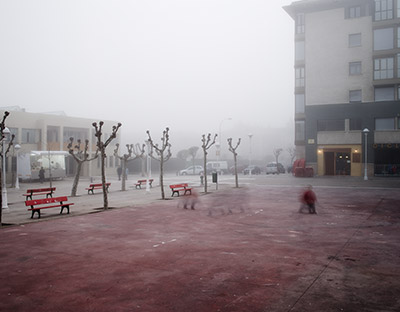
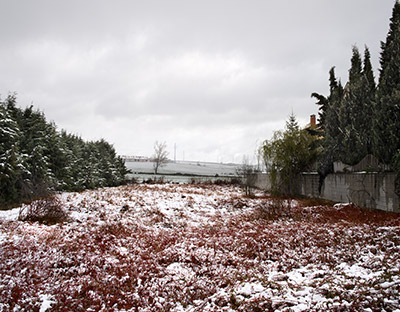
CARLOS CÁNOVAS. SEVENTH HEAVEN
The author proposed his project on the characterization of a territory, choosing the town where he lives, Zizur Mayor, a few miles from Pamplona. His approach is reminiscent of the early photographers who sought to capture the most immediate reality around them.
Zizur Mayor is located on a hill from which the nearby city of Pamplona can be glimpsed, but it is separated from it by a highway that marks a border. The town is immersed in a vague peripheral feeling, halfway between the city and the countryside, where empty lots awaiting urban development have replaced agricultural exploitation. The theme is not unfamiliar to Carlos Cánovas, who has been dealing with this type of suburban landscape since the 1980s, but on this occasion he undertakes a systematic documentation to describe and establish the character of a single place, as in a case study.
The territory of Zizur, although not strictly speaking a suburb, nor having developed as such, accepts these conditions as a balanced paradox. In a way, Carlos Cánovas seems to reformulate these issues, summarizing them in the idea of a flexible territory, where the non-place ceases to be a space of transit or a temporary space and becomes a structure that is both stable and dynamic at the same time.
To learn more
Access the virtual tour of the exhibition In Time, by Carlos Cánovas
Available at the museum reception desk: the collectible exhibition brochure and exhibition guide En el Tiempo (In Time).
SERGIO BELINCHÓN. 'SUN PICTURES IN SPAIN'
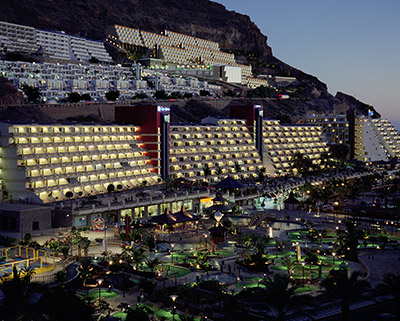
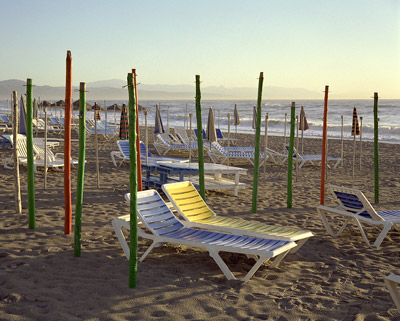
The author has constructed an image of Spain as a tourist destination, based on two albums from Henry Fox Talbot's workshop, Annals of the Artists of Spain and Sun Pictures of Scotland, in which the journey tends to emphasize an elegiac vision of Scottish nature and from which the artist borrows the title of his project: Sun Pictures of Spain. The journey along the Levantine and Canary coast reveals a continuous space of urban developments and colorful buildings that distance us from the landscape and immerse us in a territory of standardized non-places.
The dialogue with the 19th century is not only thematic, but also one of use and meaning. While the beach was a place for boats and fishermen, it was possible to take photographs linked to the picturesque. When that same space has been filled with deck chairs and umbrellas, all that remains is domestic photography, the ultimate democratization of the gaze and memory. While painting was the medium for images, only the economically powerful classes could enjoy history and memory. The development and popularization of photography led to an immeasurable multiplication of narratives, but also to a trivialization of discourse.
By focusing on tourism, Sergio Belinchón tackles a territory constructed from a perspective that passes through the compact cameras of tourists with their clichés and postcards in digital memory.
To learn more:
JOAN FONTCUBERTA. 'OROGENESIS: GIBRALTAR'
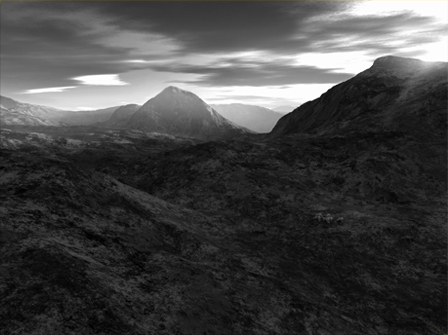
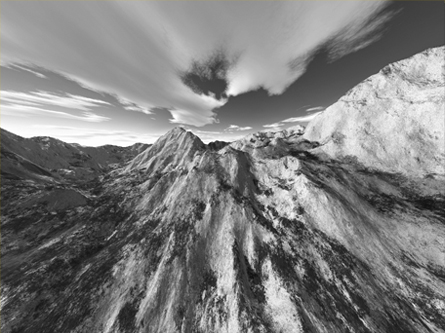
The author worked from an album of Gibraltar containing photographs commissioned by a military commission on different positions of the Rock's terrain and port. Fontcuberta converted these images into mathematical data that allowed him to generate a landscape using the Terragen program, to which he made a series of modifications.
This is a technical transfer in which an image of a chemical process is transformed into a new digital image. The new landscapes that make up the Orogenesis series have an appearance that, with their whimsical forms, seems to have more in common with the creations of the landscape gardeners described by Poe than with landscape photographers in the style of Anselm Adams, in search of the national image of a promised land. However, the objectives are very different. It is not a question of creating the image of a dream space, but rather of challenging the guidelines for describing reality and its photographic assumptions. Fontcuberta's work involves both the crisis of photographic technique and the crisis of the archive, also highlighting how the refinement of these computer programs threatens the iconic status of photography as a literal transcription of reality.
To learn more
ROLAND FISCHER. 'REFLECTIONS IN THE SHADOW'
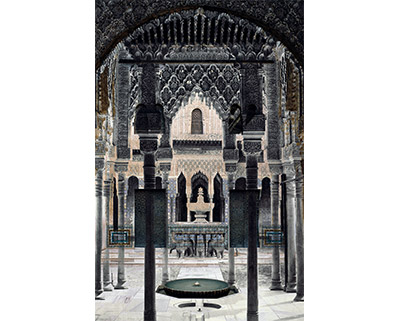
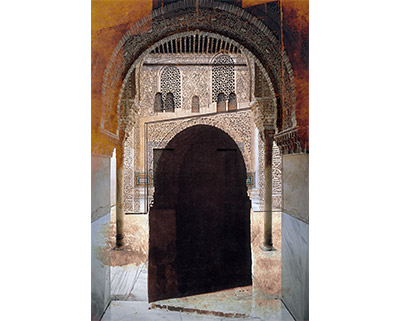
The author had worked in Spain on a project involving the cathedrals of the Camino de Santiago. For this project, he chose various 19th-century images of Toledo, Salamanca, Valladolid, and above all Granada, focusing on the Alhambra and later on the Reales Alcázares in Seville, as a bridge for dialogue. Fischer is not driven to describe the monument either. On the contrary, he undertakes a visual reinterpretation that accounts, from a more imaginative perspective, both for the character of Arab architecture, highlighting its ornamental elements and combinations, and for its visual impact and the importance of the memory of the photographic tradition in the current view.
The resulting vision is multifaceted and allows for a combinatorial and relational reading. In the images of the Alhambra, the overlapping volumes organize a diversity of planes that highlight a new and unsettling depth. His gaze takes ornamental accumulation to excess in order to emphasize the density that exists in its lightness. He combines and inserts, like an architect-gardener, constructive elements that create new effects of form and color: paradoxical visual effects that express the versatility of the architecture itself and visually reflect the internal functioning of the building. To accentuate the idea of depth in the interplay of planimetry and volume that constantly emerges in the building, Fischer uses some 19th-century images that he subtly integrates into his image, establishing a direct dialogue with the 19th century, as memory and as his own visual tradition.
To learn more
JAVIER VALLHONRAT. "42º N"
Javier Vallhonrat's encounterwith the pioneering photographs taken in 1853 by French Viscount Joseph Vigierduring his journey through thePyrenees coincides with the series of projects that the Spanish artist is developing around the experience of high mountains or environments with particular geoclimatology.
In particular, thetwo photographs taken by Vigier of the Aneto and Maladetas glaciers, which form part of the University of Navarra Museum Collection, will be thestarting point for the 42ºN project, developed over 15 months in the Maladeta Massif in the Aragonese Pyrenees.
Thedefinition of the project's strategic axes drawson elements that the artist finds through his research into the work of Joseph Vigier: theaccumulation of fragmentsor data from experiencealong numerous itineraries ina high mountain environment, theuse of geographical and cartographic data anditsinsertion into paradoxical contexts, and the establishment of a space of representationthat lies between the topographical description of the documentary model and a photographic approach that is both abstract and narrative.
42ºN has meant for the artist to look, literally and metaphorically, toward the place where Vigier directed his gaze in1853 and to explore that place, which is simultaneously geographical, phenomenal, and a constitution of language.
The photographs and video pieces that make up the 42ºN project represent, for the artist, the creation of a space for researching internal phenomena based on representations of an external territory.
Using a methodology that accumulates data (fragments)from experience as well as quantitative data (geographical, chronometric, and cartographic) resulting fromobservations made over time, andinserting theminto a paradoxical contextual framework,the artist investigatesnot so much the phenomena on which he focuses his gaze, but ratherthe language resultingfrom these interventions.
To learn more
How it was made Interactions, by Javier Vallhonrat
Visit the Interactions exhibition website
The artist talks to us about 42º
Purchase the collectible item and exhibition brochure at the museum reception desk.
JORGE RIBALTA. ‘SCRAMBLING'
Jorge Ribaltaconsidersthe Alhambra to bea post-industrial factory in four ways:
- The Alhambra as amonument, a constructed place.
- The Alhambra as atreasure, for the heritage and history it reflects.
- The Alhambra as acity, because it has a life of its own, generated by its employees and also by its visitors, who come to its public spaces.
- And finally, as aneconomy, for its vision of a monument that brings wealth.
One of the most relevant aspects of the work is the moment in which it was created, as the photographs were taken when thePatio de los Leoneswas closed to the public. The paradoxical nature of the situation also responds to theartist's intention to show the monument at a time when it cannot be seen, as well as in anew form.
According to Ribalta, his work is based on two pillars: "the photography collection held by the University of Navarra Museum, which is a very important resource for reconstructing national history; and, specifically,two photographs by Charles Clifford, namely Puerta del Vino and Templete," both from the late 19th century with the Alhambra as their subject, and which belong to that collection.
The77 pieces that make up "Scrambling" are grouped into 10 seriesthat reflect key aspects of both the creative process behind his work and the message and way in which the monument is conveyed:
- Theinspiration: an image of Chrales Clifford's Wine Tower, shown from an open book, combined with photographs reflecting the dream of a researcher viewing the archive.
- Theurban, publicpart of the monument. The rest area.
- Security. The Civil Guard helicopter flying overhead reflects the security measures put in place for a political visit. The monument's defense tower.
- Itsemployees. Understand how the monument is produced by the work of different people. Guided tour, restoration architect... Portraits of the people who make it possible.
- Gardening.
- Water. Water flow and storage. Beneath the public part of the monument.
- Stone, another key element. Series of plasterwork pieces.
- TheLions' Mouth. The restored lion.
- ThePublic. Ticket sales, halftime, buses, security...
- Commercial exploitation of the monument: shop, postcards, custom printing, etc.
The complete Scrambling series was on display in the exhibitionEverything Is True: Fictions and Documents (1987–2020), which occupied the museum's basement galleries from October 19, 2022, to March 12, 2023.
To learn more
Access the virtual tourof Todo es verdad, Ficciones y documentos, which includes Scrambling, here.
Available at the museum reception desk: the collectible exhibition brochure and information sheet for the exhibition Everything is True, Fictions and Documents.
BLEDA AND ROSA. THE ALHAMBRA
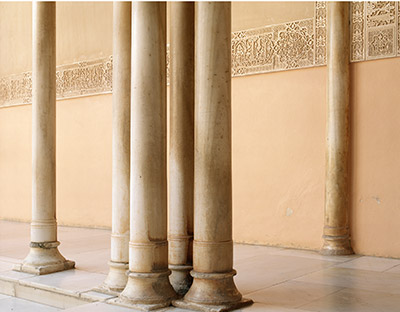
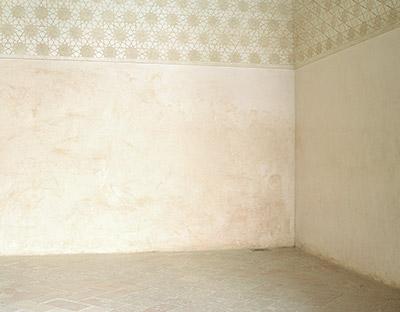
The authors embarked on their project on the Alhambra by deconstructing the monument, starting with a tour of intermediate and transitional spaces that could convey a sense of familiarity and everyday normality. The project proposes two complementary routes, one that penetrates the interior and observes the guts of the monument, and another that runs along the perimeter, allowing visitors to observe the landscape and enjoy views of the surroundings.
It was the first time the photographers had visited Granada, but their initial impressions were already influenced by a photographic iconographic tradition that had been meticulously documenting the monument since the 19th century. Taking on the role of traveling photographers, they contemplated the complex while thinking about their predecessors and the images they had left behind. Bleda and Rosa barely paused in the courtyards, focusing instead on the spaces connecting the halls and gardens, on the worn walls of the intermediate rooms. It is these non-monumental spaces that attract their attention, as they reveal in a more natural way the residential character and use of the palace. When the photographers looked for possible locations for landscape shots, they realized that the trees had grown excessively and their crowns obscured the view of Granada. Like a wall of vegetation, the trees stood in the way like a veil, allowing only glimpses and fragments of buildings to be seen. The landscape thus excludes panoramic views and allows the images taken in the 19th century to surface in the memory.
To learn more:
MARTÍ LLORENS. 'STRATA'
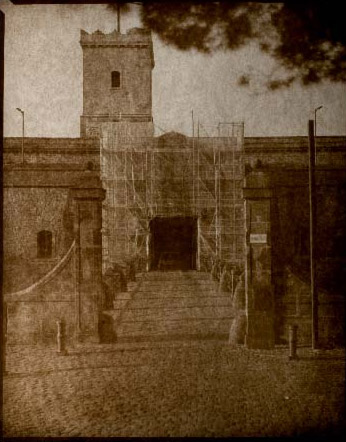
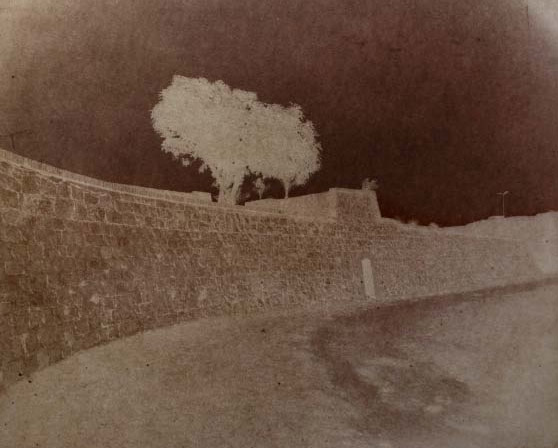
This project focuses on the Montjuïc Fortress in Barcelona, a place that has been part of the city's history, memory, and imagination since the mid-17th century.
This project aims to observe, reflect upon, and represent this place as a strange space outside of time and context, questioning it as a lost object that is definitively alien and foreign to its initial value of use. In the wake of this lost object, the photographs have been taken using a 19th-century technique devised for architectural and landscape photography: waxed paper negatives. The final piece is no longer a positive image but the negative itself, thus becoming an object alien to its initial value of use and, of course, completely foreign to the world of digital imaging. The production and processing of these negatives, the weight and volume of the equipment used, the long exposure and development times, in short, the pace and type of work required, are also completely foreign to what we have long conceived of as photography. These and other contingencies are what give these photographs an essential and sought-after antagonistic time, a precious element in this project.
For Llorens, his taste for working with history, traces, and memory leads him to work on the concept of artistic creation understood as a means of recovering objects, a recovery that leads to new and unexpected uses.
XAVIER RIBAS. ‘CONCRETE GEOGRAPHIES (CEUTA AND MELILLA)'
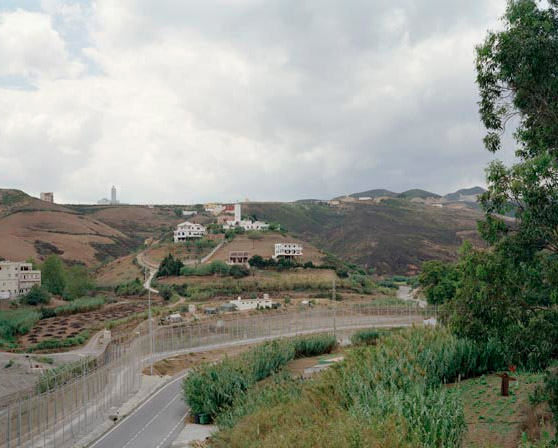
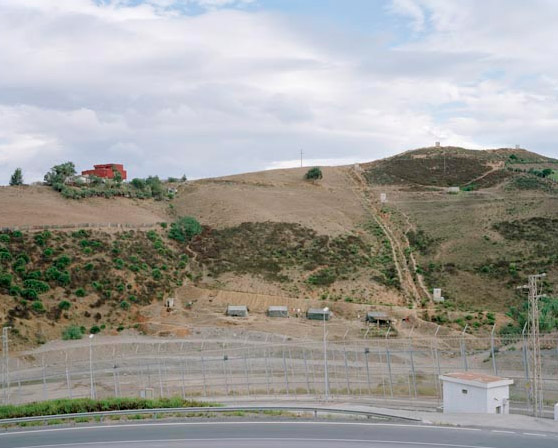
The project carried out byXavier RibasforTender Puentesaddresses therepresentation of the contemporary European landscape through two photographic journeys along the border fences of Ceuta and Melilla. Geografías Concretas (Ceuta y Melilla) consistsof two photographic grids of 22 and 26 photographs each, in which the author visualizes thelandscape defined by these fences, which simultaneously delimit a colonial/national border between Spain and Morocco, aneconomic border between Europe and Africa, ageopolitical border between North and South, and areligious border between Christianity and Islam.
As Xavier Ribas himself explains, "the border fences of Ceuta and Melilla are to the European landscape of the 21st century what bridges, tunnels, and railways were to the landscape of the second half of the 19th century and early 20th century."
In thephoto albums of public works by authors such as Clifford, Laurent, Minier, and José Manuel Sánchez, from the University of Navarra collection, bridges, roads, tunnels, and railways shape anew landscape marked by the desire for openness, movement, circulation, exchange, and communication. The border fences of Ceuta and Melilla alsodefine a new landscape, but this time it is alandscape of secession, an architecture of exclusion, born of poverty and openly racial.
In the words of Xavier Ribas, these photographs aim to be "statements towards a political cartographyof the border fences of Ceuta and Melillaas the true frontier of Europe. The fences of Ceuta and Melilla are the contemporary public works that best define, as monuments to inequality, the European landscape of the 21st century."
To learn more
VALENTÍN VALLHONRAT. 'ORNAMENTAL PHOTOGRAPHY'
His work initially focuses on revisiting the concept of the album as a possible prototype for the archive, before going on to discuss the notion of authorship and the dialogue with a tradition of photographic documentation.
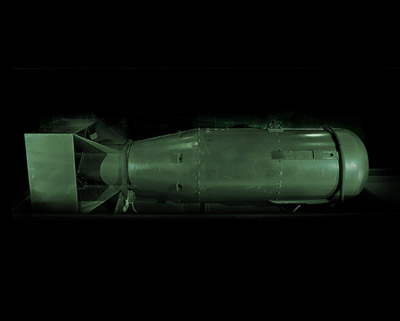
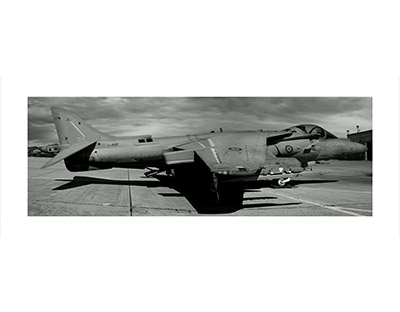
His project has expanded over time and has run parallel to the development of Tender Puentes, of which he is one of the driving forces, refining and narrowing down its theoretical framework. The starting point for the project is the albums documenting the Royal Armory of Madrid, which were produced in the 1860s. Valentín Vallhonrat begins with a visual reinterpretation of the helmets, shields, and armor present in the Madrid Armory and the Imperial Armory in Vienna, which are treated in relation to the descriptive model applied by Clifford and Laurent. At the same time, his interest is directed towards contemporary weaponry, helicopters, airplanes, submarines, and projectiles, as technological equivalents of armor and as machines endowed with beauty that summarize the character of contemporary models of efficiency (in this case, efficiency of destruction).
Images of contemporary weaponry alternate with almost solarized color documentation of historical armor and gauntlets, some enclosed in display cases, highlighting the continuity of an archive.
To learn more:
JORDI BERNARDÓ. GIBRALTAR
This author's training in areas related to urban planning and architecture has enabled him to understand how the contemporary territory is articulated based on a configuration of non-places, which end up being spaces of cultural significance despite their emptiness.
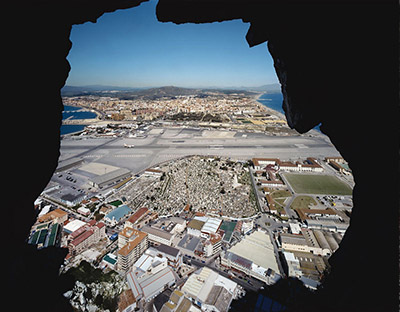
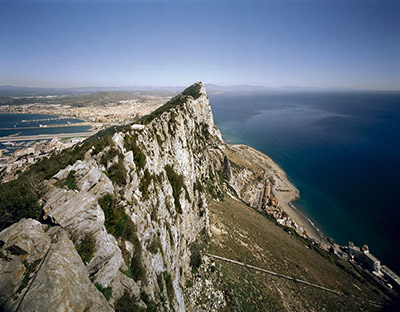
The term non-place was coined by Marc Augé and has been used to describe the articulation of contemporary space and territory through anonymous and standardized places of transit. Jordi Bernadó travels through Gibraltar with a more analytical than descriptive gaze, highlighting the peculiarities of a theme park that has the scale of a territory. Tourism and entertainment intersect with a military base, whose history is displayed in an informative way, with wax figures staging anecdotes and historical events.
Tourism does not entirely define the territory of La Roca, but it does offer content and meaning to its strangely decorated landscape. The connection between the photographs in the project and the images in the 19th-century albums is very direct and tends to show the changes that have taken place in the ways in which places are understood. While the album emphasizes the topographical, the project is dominated by the strangeness of today's non-places, which tend to short-circuit critical observation.
To learn more
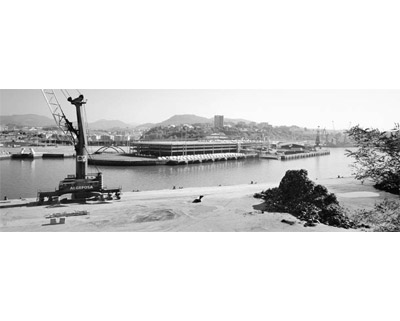
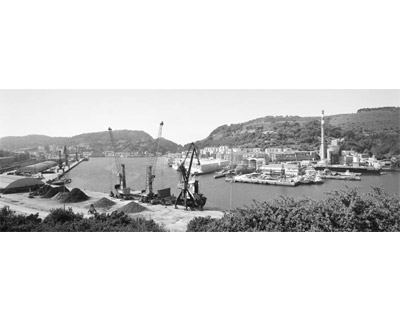
Gabriele Basilico
The author takes a look at the industrial urban landscape on a journey that includes the municipalities of Pasaia and Lezo, and reaches San Sebastián.
After graduating as an architect in 1973, Gabriele Basilico devoted himself extensively to documenting cities and their urban and industrial landscapes. His project for Tender Puentes, carried out through black-and-white panoramic photographs, takes us back to his first major project, carried out between 1978 and 1980, on the industrial outskirts of Milan.
In his work carried out in northern Spain, the author revisits his concern with exploring contemporary cities and landscapes, generated by the transition from the industrial to the post-industrial era, with the profound architectural and urban changes that this transformation has brought about, especially in the industrial suburbs of many European cities. The images presented combine the harsh industrial image with the poetics of environments recovered for iconographic memory.
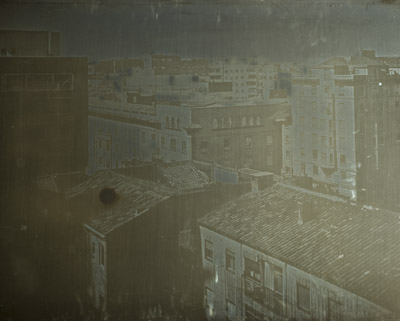
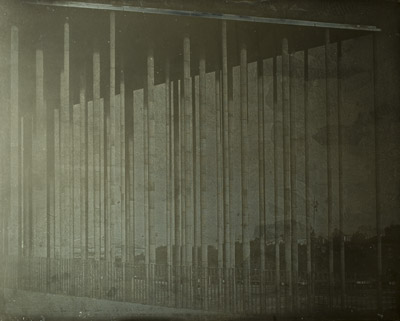
ANGEL FUENTES
The author carries out his project as a tribute to the discovery of photography itself. He prepares his material by scrupulously following Daguerre's first manual, which appeared in Paris a month after the French government decided to release the process from any type of patent. Following the instructions in this manual, the silver surface is sensitized with iodine vapor until it turns an intense yellow. The sensitivity of the plate is very low, so outdoor shots will take a similar amount of time to those taken 170 years ago, i.e., between 20 and 30 minutes depending on weather conditions.
Prolonged exposure produces an effect similar to solarization in the highlights. We can see this clearly in the earliest examples of the photographs Daguerre took from his studio.
From his studio, Ángel Fuentes takes a series of three shots, in which the iconic content is subject to the problem of solarization itself. For the shot, he chooses three different days, at exactly the same time, and points the camera in three different directions, seeking three different lighting conditions: balanced light and shadow, very strong light, and very pronounced shadows. The next series is taken at street level. He faces the buildings and surroundings left behind after the Zaragoza International Exposition.
The result documents the difficulties encountered by early daguerreotypists: flat-looking images combined with the mystery and beauty produced by opaque-looking metal objects.