
From Laboris. Pierre Gonnord
Through his portraits, photographer Pierre Gonnord immortalizes the image of the individual, alone and anonymous, but belonging to a family, a clan, a group, with well-defined roots deeply embedded in an ancestral culture, respecting the mystery that surrounds them.
OPENING. APRIL 27

The origin of Pierre Gonnord's ( Cholet, 1963) work De Laboris lies in the Museum's commission for him to participate in a project in the Tender Puentes series, based on the Museum's photographic collections. In the Museum's photographic collections, Gonnord discovered portraits by photographers of the past, such as Napper and Laurent, but above all Tenison.
Gonnord's gaze focuses on characterswho bear the weight of lineage and tradition. These anonymous faces stir our emotions and become transcendent, timeless, and eternal. Gonnord's work in De Laboris is based on the theme of portraiture, which he himself describes as silent interpellations that soberly narrate unique stories through simple language. The photographer captures these figures and restores their dignity, photographing them in close-up, full-length or bust, gazing into infinity, oblivious to the lens, the photographer or the audience that contemplates them and whose presence makes them real and eternal.
His photographs reflect empathy with the problems and life experiences of those portrayed. To achieve this, Gonnord gets involved with these individuals and groups, living with them, getting to know them and understanding their essence, discarding what does not interest him and choosing those who will become the subjects of his portraits, seeking to capture their charisma.
In Los Gitanos de La Raya , he focuses on a racial group that, even though they live in our times, symbolize in the collective imagination a people exiled for centuries, struggling for survival and preservation in the face of globalization. They are a nomadic group that lives between Spain and Portugal, and they embody the mixed heritage of the different races that populated the Iberian Peninsula along with that of the Gypsy people.
While in The Minersreflects a world already in decline, of heroes forged in the early days of the labor and union movement. Gonnord portrays the miners of the Asturian-Leonese basin, where workers native to the region and heirs to long dynasties linked to the mine now coexist with immigrants from different European mining basins, who are also heirs to an ancestral tradition linked to a hard and difficult working world, but one that is young and vital, composed mostly of men.
PIERRE GONNORD
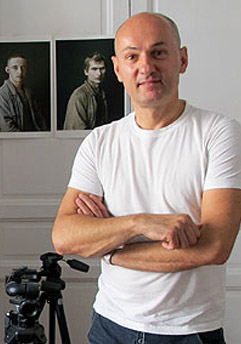
Gonnord's work focuses primarily on human faces. Examples of this are his works Interiors (Madrid, 199), City (New York, 2001), and Utópicos (2004-2005). These works feature sequences of very diverse portraits, in which Gonnord chose to focus on characters marginalized by society and photographed them in close-ups of their faces: they were homeless people, prisoners, the mentally ill, or the blind, but also monks, geishas, and members of urban gangs.
He has exhibited in numerous public and private galleries, such as the Conde Duque Cultural Center, the Maison Européenne de la Photographie in Paris, the Museum of Fine Arts in Seville, the University of Salamanca, the Atelier des Forges, Les Rencontres d'Arles, the FRAC Auvergne-Ecuries de Chazerat in Clermont-Ferrand, and the Helsinki and Oslo Photography Festivals.
Date
April 27, 2016