
Camouflages. Joan Fontcuberta
Even today, both in everyday life and in the strict context of artistic creation, photography appears to us as a technology at the service of truth: the camera bears witness to what has happened, writes Joan Fontcuberta in El beso de Judas (1997).

Herbarium (1984) [1],the oldest of the projects featured in Camouflages, presents a collection of unique plants, photographed in close-up against a neutral background. In style, Herbarium follows the model of early 20th-century scientific repertoires, particularly the project by Karl Blossfeldt, who in the early decades of the 20th century created an extensive herbarium with close-ups of plants with surprising shapes, very similar to the Art Nouveau aesthetic then in vogue. Based on this model, Fontcuberta developed a parodic herbarium that pays homage to Blossfeldt's work.
Fauna (1987)[2], produced in collaboration with Pere Formiguera, tells the story of Professor Peter Ameinsenhaufen, a scientist who, at the beginning of the 20th century, undertook a search for hybrids and genetic mutations. The result is an extensive zoological collection, which includes documents, photographs, and stuffed animals, giving an idea of Ameisenhaufen's discoveries, such as Corcopithecus icarocornu, a long-tailed ape with large wings found in the Amazon rainforest, which hunts thanks to the powerful horn on top of its head.
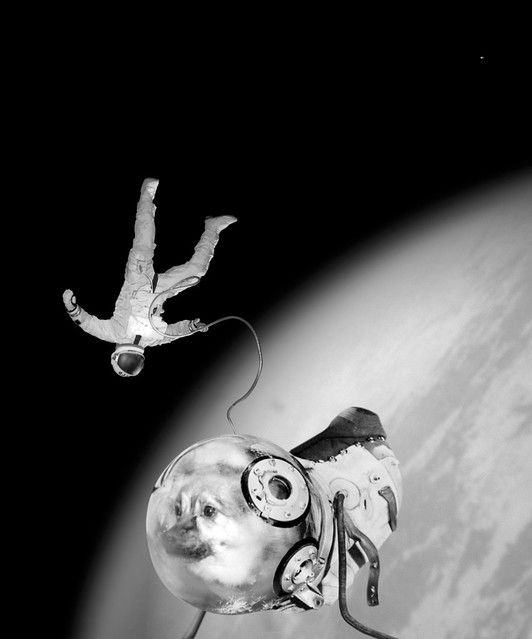
Sputnik (1997)[3] tells the story of Ivan Istochnikov, a Soviet astronaut who disappeared after the failure of his mission in 1968. Although he was a famous figure at the time, the USSR did not want to acknowledge the failure of his mission and erased Istochnikov from the archives, consigning him to oblivion. Only the emergence of private documents after the fall of the Wall has made it possible to reconstruct the story of this figure through photographs, letters, and objects that show the heroism and public importance of Soviet astronauts during the Cold War years.
Constellations (1993),the ambiguity of scientific images is continued in a parodic manner in this series. In Constellations , the images show what appear to be a series of views of constellations, whose data is indicated in the titles, which provide accurate information about the place and time the images were taken.
The Artist and Photography (1995)[5], aims to recover unknown works by some of the great masters of art from the last century (Picasso, Miró, Dalí, and Tàpies) to show their relationship with the medium of photography. Thus, direct photographs, photograms, photo collages, and other works are presented that show how photography has served as a creative stimulus for many of the great creators of the 20th century.
Camouflages (2009) [6], consisting of six variations on The Knight with His Hand on His Chest. In each of them, part of El Greco's work is discreetly replaced by one of Joan Fontcuberta's own body parts, which thus appears camouflaged within the classical portrait. Its theme, one might say, is the changing identity of the artist, whose activity is divided into the various tasks discussed in the previous projects. This fragmentation is also reflected in the presentation of this series, not as a coherent whole in a specific room, but scattered throughout different parts of the museum that would not normally correspond to it.
Orogenesis (2002)[7], extends the problems of authorship, veracity, and construction to the digital age. Fontcuberta resorts directly to artifice: using a computer program, he generates fictional landscapes that respond to the clichés of Romantic aesthetics. The University of Navarra Museum houses a complete series of these landscapes, created from a military album of views of Gibraltar belonging to the Tender Puentes program.
JOAN FONTCUBERTA
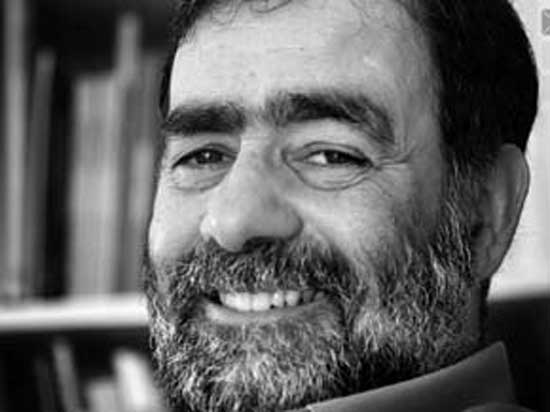
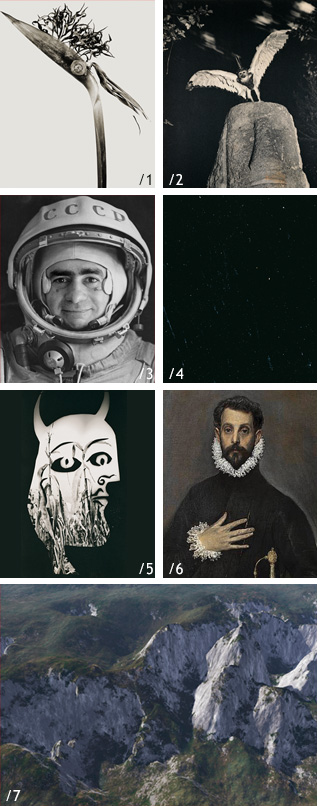
His creative work, which deals with the conflicts between nature, technology, photography, and truth, has been the subject of solo exhibitions at the MoMA, New York (1988); the Musée Cantini in Marseille (1990); the Art Institute of Chicago (1990) ; the MNAC, Barcelona (1999); the Palazzo delle Esposizioni in Rome (2001); Aperture Foundation, New York (2006); FOAM Fotografiemuseum, Amsterdam (2010); Casa de la Moneda, Bogotá (2011), among many others.
His works can be found in collections such as those of the Metropolitan Museum of Art (New York), San Francisco MoMA, National Gallery of Art (Ottawa), Musée d'Art Contemporain-Centre Georges Pompidou (Paris), Maison Européenne de la Photographie (Paris), Stedelijk Museum (Amsterdam), MACBA (Barcelona), and the University of Navarra Museum.
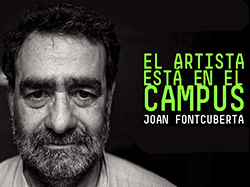
CONFERENCE BY JOAN FONTCUBERTA
WORKSHOP "AN EXPERIMENT WITH TIME"
Further information: Download pdf
EXHIBITION CATALOGUES
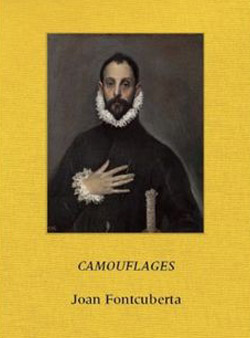
Camouflages, Joan Fontcuberta
Fontcuberta's exhibition is complemented by this catalog, which describes the projects that make up the exhibition. The artist engages in dialogue with profound ideas of the modern era: the power of the discourses that shape our view of the world, the place of the artist in society, and the role of humor in the face of authority.
Price: 30 ac |
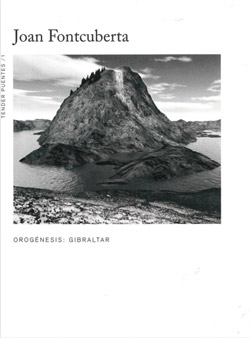
Orogenesis, Joan Fontcuberta
Available in stores and online |
SOME WORKS FROM THE EXHIBITION
ACKNOWLEDGEMENTS
MACBA
Obra Social "la Caixa"
University of Navarra Science Museum
Pamplona Planetarium
Dr. Romero Nieto Foundation
Fermín Alvira
Javier Landa
Date
April 13, 2016