
Memorandum
Luis Gordillo
February 3, 2021 - September 19, 2021
Ground Floor and Tower Room
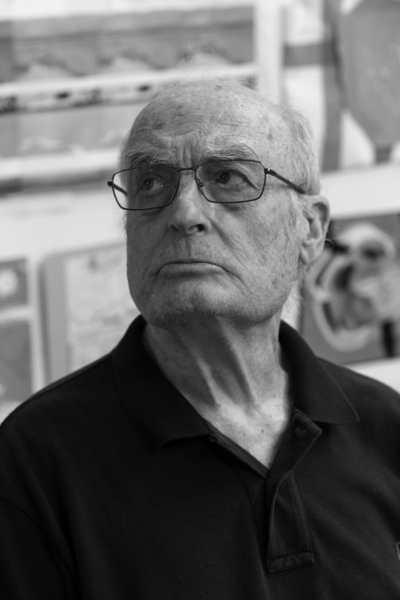
Described by Gordillo himself as one of the most ambitious exhibitions of his work, this show, curated by Sema D'Acosta, brings us closer not only to the Sevillian artist's work, but also to a reflection on his approach to the creative process.
Curator: Sema D'Acosta
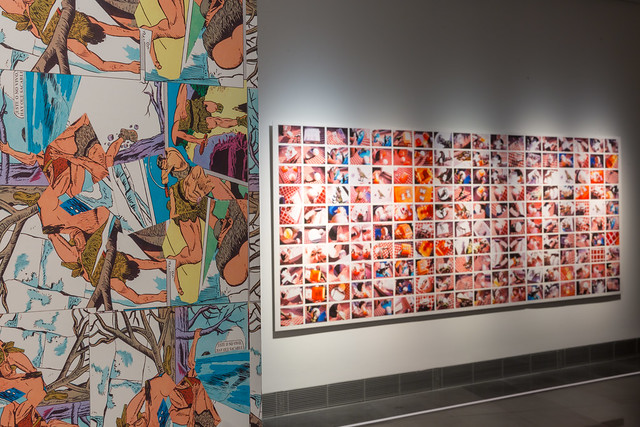
The project presented by Luis Gordillo (Seville, 1934) at the University of Navarra Museum is conceived as a retrospective in which his major works from the 21st century can be viewed in dialogue with other emblematic pieces and series from his earlier career. At the same time, this exhibition takes an in-depth look at the most notable lines of research from this latest period, placing special emphasis on the constant feedback between painting and photography, a characteristic territory of the author where the image in process defines internal configurations that construct the work. Memorandum is conceived as a living space that eschews the white cube and tends toward the scenographic. Its aim is to involve the visitor, to show them the tensions and energies that Luis Gordillo's work gives off from within, offering a double perspective: on the one hand, a macroscopic view of related families of paintings or recurring themes in his career; on the other, a close observation of the combustions, explorations, and drifts that are generated in the studio.
BIOGRAPHY
|
|
The long artistic career of Seville-born Luis Gordillo (1934) reveals a personal eclecticism that blends pop art with informalism and geometry. Irony, the use of color, and technological research into images and their uses reveal the dichotomy between direct, expressive work and controlled, clean, perfectionist execution. Unclassifiable and personal, his work has received important national and international awards. Luis Gordillo was born in Seville in 1934, the second of eight children. He studied law and music and later decided to become a painter. He attended the School of Fine Arts in Seville for two years. From 1958 to 1960, he lived in Paris, where he studied museums and film archives in depth and, above all, experienced a climate of freedom in life and reading that was difficult to find in Spain at the time. Upon leaving Paris, he entered a crisis and did not paint again until 1963, returning with a pop aesthetic and his famous Cabezas series. From 1970 onwards, after his profound crisis, he began to paint colorful pictures with a new element: irony. In the 1980s, his painting became more abstract and less colorful, but he continued to retain the influence that mechanical techniques such as offset printing, photography, and more recently, the computer, had had on his work since the 1970s, as part of his extensive research into the transformation of images and media. Velázquez Prize for Plastic Arts 2007, National Prize for Plastic Arts in 1981, Community of Madrid Prize for Plastic Creation and Andalusia Prize for Plastic Arts in 1991, CEOE Prize for Plastic Arts in 1992, Gold Medal for Merit in Fine Arts in 1996, Tomás Francisco Prieto Prize from the Casa de la Moneda in 1999, Ciutat de Barcelona Prize for Plastic Arts in 2000, Aragón-Goya Prize for Painting in 2003, and Gold Medal from the Círculo de Bellas Artes in Madrid in 2004. In 2008, he was awarded the Order of Knight of Arts and Letters of France by the French Ministry of Culture and Communication. |
|
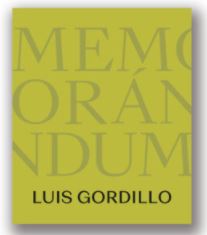 |
Memorandum - Luis Gordillo A carefully crafted volume, essential for understanding the artist's work, designed specifically to allow readers to experience the exhibition on display at the museum. |
|
| Curator and artist in conversation: | ||
| The exhibition in brief: |
Photographs from the exhibition

Photographs of the room
Sema D'Acosta brings us the work of Luis Gordillo
Gordillo spun out. Alfonso De La Torre
Contemporary harp - Alicia Griffiths
February 13, 2021 / 6:00 p.m. and 8:00 p.m.
School and Educational Programs
School programs, for families, and for everyone