
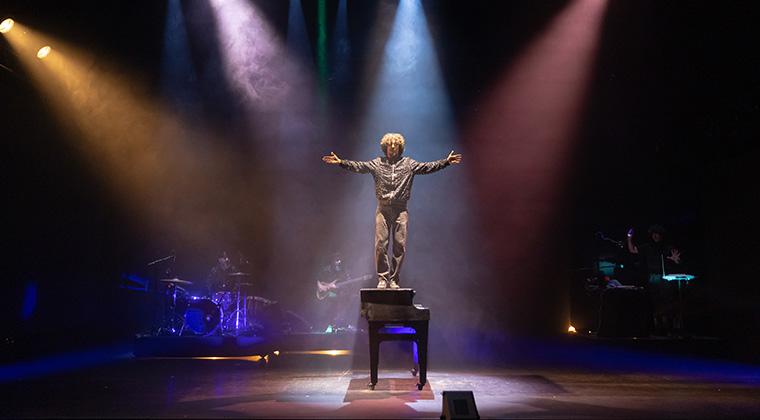
Dancer and choreographer Jesús Carmona collaborated with a group of experts from the University, the Clinic, and Cima Universidad de Navarra to develop Súper viviente, a show about dissociative identity disorder and other mental health issues. These researchers contributed their expertise in psychiatry, psychology, arts education, and neurology.
Carmona presented the world premiere of this show on September 26, 2024, with María Cabeza de Vaca as co-artistic director.
Co-produced by MUN and the Jesús Carmona Company, with the support of the Community of Madrid, Súper viviente was made possible thanks to members of the promoting board of trustees.
TO LEARN MORE
Related activities
More about Jesús Carmona's collaboration with researchers
The MUN: a meeting point between art and science, and between artistic disciplines
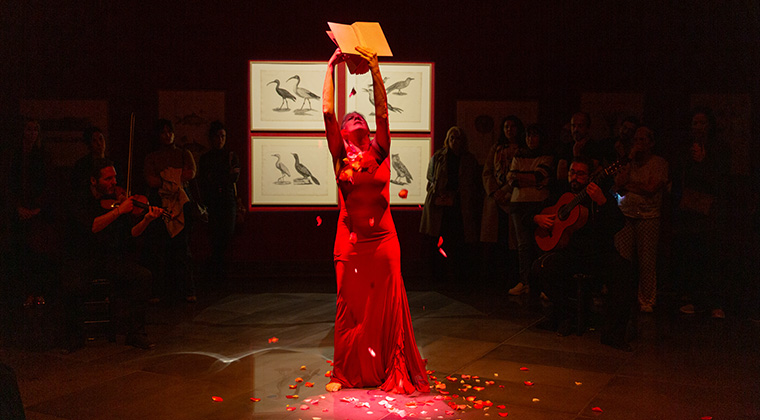
María Pagés and El arbi El Harti, invited by the artistic direction of Performing Arts and Music, are the authors of this choreographic creation project inspired by the exhibition A Promised Land, from the Age of Enlightenment to the birth of photography. The project is part of the Museum's artistic residency program.
Tierra prometida (Promised Land ) is a stage performance created specifically to interact with the exhibition of the same name , Una Tierra Prometida. Del Siglo de las Luces al nacimiento de la fotografía (A Promised Land: From the Age of Enlightenment to the Birth of Photography).
Produced by the María Pagés Company and the CCPM, in collaboration with the University of Navarra Museum, this performance choreography has an inclusive vocation. In it, choreographer María Pagés and playwright El Arbi El Harti invite flamenco dance, photography, and museum scenography to conceive a new scenic semantics. They combine the fertile energy of flamenco dance with the aesthetic and ethical beauty of the museum and the exhibition in a welcoming alloy.
In Tierra prometida, dance approaches the genesis of photography, dialogues with it, and sublimates it. Photography and dance share the same poetic essence and the same link with space, time, reality, movement, and harmony... A photograph is a snapshot that tells a story. A choreography is a succession of snapshots that seek to tell history from the ethical emotion of a creative imagination.
The imagination has always needed symbolically fertile territories. The East undoubtedly meets this requirement. It adapted very well to the existential need for estrangement that the West required at that time. The translation of The Thousand and One Nights, the publication of dictionaries, the writing of essays, the creation of theater, novels, poetry, and short stories, the fascination with distant countries, diplomatic relations with the Gate, and intellectual interest in the Koran are nothing more than proof of this endeavor to discover a world located in deeply evocative territories.
All this work, which began in the 18th century and had much of an almost convulsive creative tenacity, was an invitation to the other, through an aesthetic of the unknown, an aesthetic of exile, of rewriting.
The project was supported by Paula Orozco and Álex Ventós.
FURTHER INFORMATION
Video summary
Making of
The event
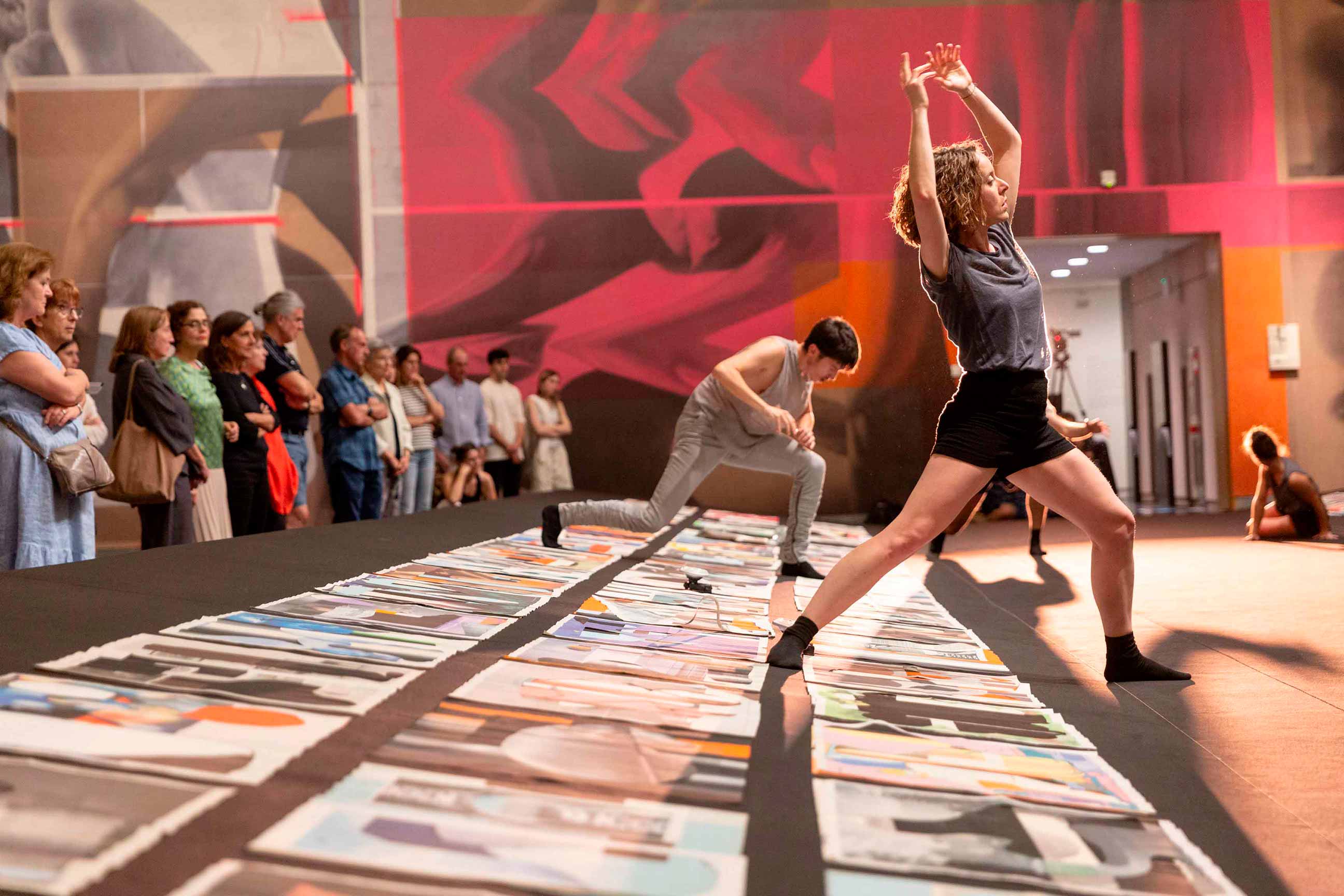
At the Museum's residences, artists' creations are inspired by pieces from the Museum's collection. On this occasion, the project went further and created a space for collaboration between visual artist Fernando Pagola, with his exhibition Triple Concierto, and choreographer and dancer Jon Maya.
Both artists shared their concerns and reflections on issues such as the movement of the human figure, the power of tensions and their expression in the body, and the plasticity of the various artistic disciplines. Finally, on June 16, 2023, the choreographic intervention Tres Movimientos (Three Movements) was shared with the public as part of the Triple Concierto exhibition. Both creations, the visual and the choreographic, merged into a dialogue in which the audience took part.
To learn more:

The choreographer and dancer draws inspiration from Pharsalia, apoem by Lucan, a 1st-century author from Cordoba, to talk to us about war from an allegorical perspective. To complete his research process prior to the choreographic creation, the choreographer enlisted the help of the research community at the University of Navarra. The project was joined by philologists, archaeologists, and philosophers who worked alongside dancers, designers, lighting technicians, and others. In this way, the project brought together artistic and academic approaches.
The result of the creative process resulting from the residency was previewed at the University of Navarra Museum.
To learn more:
October 14, 2022, 7:30 p.m. ·Pharsalia. Antonio Ruz Company
October 11, 2022, 7:00 p.m. · How to do things with... Lucan's poemPharsalia. With Olga García, Antonio Ruz, and Álvaro Sánchez Ostiz
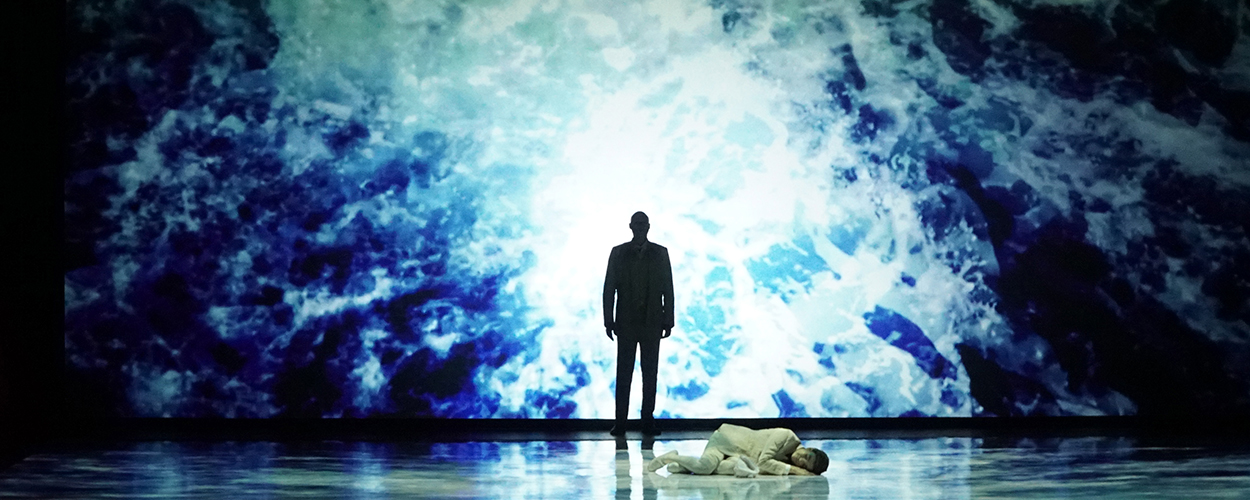
Stage proposal:
Atlantis, by Manuel de Falla.
Music by Manuel de Falla and Ernesto Halffter
Co-production:
Pamplona Chamber Choir and University of Navarra Museum
The world premiere of Atlàntida in its chamber version took place at the University of Navarra Museum on March 5, 2022, as part of the Cartografías de la Música series .
Previously, Atlántida, en busca de la esencia was presented on November 21 at the Gran Teatro Falla in Cádiz, as part of the XIX Festival de Música Española de Cádiz | Manuel de Falla, in a semi-staged chamber version for voice and piano four hands.
The project was supported by INAEM, the Government of Navarre, Pamplona City Council, and the Manuel de Falla Archive.
Access information about the event at
Notes on the museum's performances at
Here is a video summary of the event:
The piece stems from its creators' desire to promote dance and attract audiences from the very conception of the work... and to do so, they asked themselves: why not involve the audience from the very beginning of the creative process?
To this end, a call was made to anyone who, although not involved in the world of dance, was interested in participating in a process of this nature. The resulting group was given the name and status of "Working Group" and participated in the creation of the piece at all stages.
A large part of that working group were university students who highlighted the experience and became the best advocates for contemporary dance.
The participatory process posed a significant challenge for the company, which established an ambitious schedule beginning on September 17 and culminating in the premiere of the piece on November 6, 2021.
The piece was part of the Museo en Danza 2021 cycle and received two awards at the 25th edition of the Max Awards for the performing arts, for Best Choreography and Best Lighting, awarded to Nicholas Fischtel.
To learn more:
Access the event website
Creative project website on Campus
Max dossier on the work
Access the event press site
Access the summary of Museo en Danza 2021
Life lived and yet to be livedis a participatory theater project born out of the concerns of José Manuel Garrido, former artistic director of the Museum, who raised questions about the role of older people in our society in the wake of the pandemic.
He shared his concerns with Tomás Muñoz so that they could respond to these concerns through art and theater. Pepe Galera soon joined the project.
The artistic team held auditions for people over the age of 60 with no previous theater experience. The group of participants, accompanied by the artistic team, underwent a process of reflection, refinement, creation, and staging, which resulted in the theatrical production of the same title. The world premiere of the play took place on April 24, 2021, at the theater of the University of Navarra Museum.
The project attracted the interest of the media and other cultural agents. The experience will be replicated in the region of Murcia, and the group of new actors will tour Navarre, bringing the play to other towns.
The initiative was part of the QUIDARTE project, which was supported by the Obra Social la Caixa Foundation and the Caja Navarra Foundation.
Access the project development
Access the summary of the Quidarte project
Access the UN's digital content platform to watch the full recording of the play.
El Cantar de Cantares (The Song of Songs) isa poetic theatrical production by director Ignacio García, who was invited to participate in the creative residency program at the University of Navarra Museum. In this program, guest artists draw inspiration from the museum's collection, spaces, or projects to create a new work.
Ignacio García visited the MUN Photographic Archive on February 21, 2020, following a previous visit in November 2019. Since then, discussions have been ongoing to shape this project. This is howEl Cantar de Cantares(The Song of Songs) was born, in Fray Luis de León's octave rhyme translation, based on photographs by José Ortiz Echagüe, whose collection belongs to the Museum, and music by Ignacio García himself based on melodies by George Gurdjieff, Antonio Vivaldi, Bárbara Strozzi, the Mancuso brothers, Nityn Shawney, and others.
The public was able to attend the world premiere of the play, in work-in-progressformat ,on January 23, 2021. Subsequently, it was chosen as the representative piece of theatrical production in the Autonomous Community for its presentation at the Almagro International Theater Festival, in which Navarre was the guest province.
In 2021, theMITEM International Theater Festivalin Budapest included the play in its seventh edition as the only Spanish representation in the program. Access the clipping from the festival here.
The work is the result of the artist's residency at the Museum, which began in late 2019. The project has received support fromthe INAEMandPamplona City Council.
The embrace of a girl and a man. That gesture of affection and sensitivity captured byJosé Ortiz Echagüe'scamera was the image that inspired choreographer and dancerDaniel Abreuto create Desde la ternura, a site-specificpiece developed in dialogue with the architecture and exhibitions of the Museum.
Abreu was captivated by a photograph entitledLa ternura(Tenderness) from the Collection. "I had some artistic concerns that had a lot to do with emotions, and then I came across this photo. I could see different tones in the development, and I was struck by the fact that there was something in the gestures that gave rise to a much broader interpretation."
DancersDácil GonzálezandArnau Pérezand musicianHugo Portasaccompanied him in the project, promoted byTeresa Lasheras, director of Performing Arts and Music at the Museum.
In Abreu's words,Desde la ternuradoes not propose "a representation of that photograph" but rather to share with the audience "stories about tenderness": "Tenderness is the driving force, the concept I wanted to work with. But beyond that, there is awonderful building, a fantastic architecture that allows us to move around many places. This physical, musical, and theoretical framework began to take shape during these days of residency." In this sense, he pointed out that the creative process of this piece is "very fluid" and that "it raises many questions, especially in a context where everything is changing."
“(...) Hugo Portas'live music, in addition to the pre-existing music, which creates many different atmospheres, the fixedchoreographyand thefreedom ofthe performers are linked around a series of gestures captured by Ortiz Echagüe: a hand that fails to comfort a girl and she, who fails to touch a father or grandfather.” Thus, the piece offers interpretations that are above all questions about "why, what for, what is tenderness, what does it entail, where does it come from and where is it going."
DancerDácil Gonzálezemphasized that "it's wonderful to transfer physical material from a studio to the museum: here it comes to life, transforming and adapting to each space. The architecture of the space, the content given to the space where we work, and the way we inhabit the place is very interesting." ForArnau Pérez, it has been an "enriching" experience that has allowed him to take his body to different places or places that he found more fragile. There has been a very interesting conversation about how the three bodies on stage change and how these conceptual ideas resurface.
Hugo Portas, who was in charge of the music performed live, explained that the pieces were mainly Baroque, "versions transposed to a contemporary instrument such as the tuba."
Abreu already presented his show in November 2020. El hijoas part of theMuseo en Danza cycle, and he facilitated a dance workshop during the same season.
To learn more...
More information about From Tenderness
Access the video summary of Museo en Danza 2020


JON MAYA
After the lockdown period, in October 2020, the public rediscovered dance in #Gauekoak, the piece by Kukai Dantza that closes this "chronicle of a lockdown" and the artistic residency of Jon Maya's company at the University of Navarra Museum.
On October 10, 2020, this piece kicked off the third edition of Museo en Danza.
Access to the Gauekoak teaser and Jon Maya's Masterclass
In October 2021, the Creation Notebook dedicated to this project was published.
The lockdown experienced due to COVID-19 has exposed us all to new situations and challenges, which the creative community faces and interprets from its own perspective. This new situation was the subject of debate and reflection between Jon Maya, director of Kukai Dantza, and José Manuel Garrido, director of Performing Arts at the University of Navarra Museum.
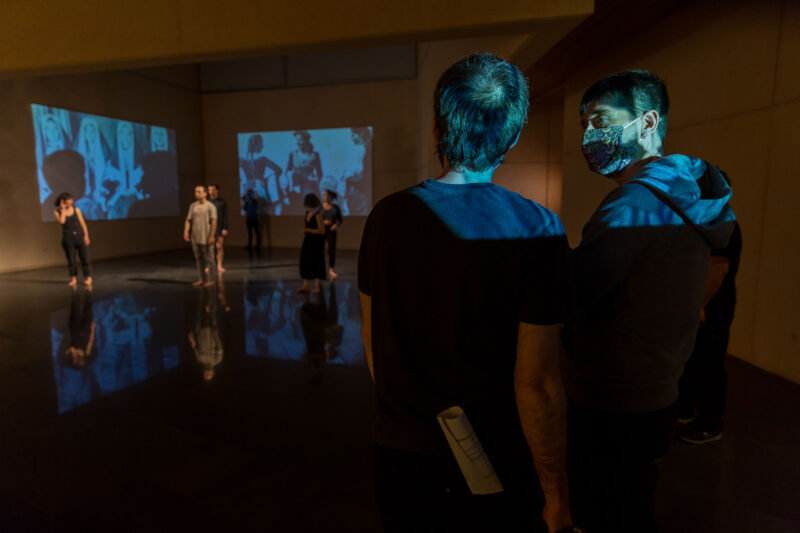
This reflective process, both individual and shared, has given rise to an artistic residency project conceived during the period of isolation, which took shape during a week of intense work at the Museum, resulting in a new creation entitled "Behind Closed Doors," one of the first creations to emerge from the artistic concerns of Kukai Dantza and the University of Navarra Museum in response to the historical context we are currently experiencing.
The creative process triggered by these conversations follows its own rhythm of de-escalation, adapting at every moment to the constraints of the environment. Creation begins in the solitude of individual confinement, before reaching its particular "phase 1"; that moment when rehearsals begin separately, and each dancer experiences the impact of reconnecting with the physicality of dance and the joy of sharing the choreographic process, even without being able to meet physically. It will not be until phase 2 that they will meet again and enjoy sharing this choreographic work in the same space, the rooms of the Museum.
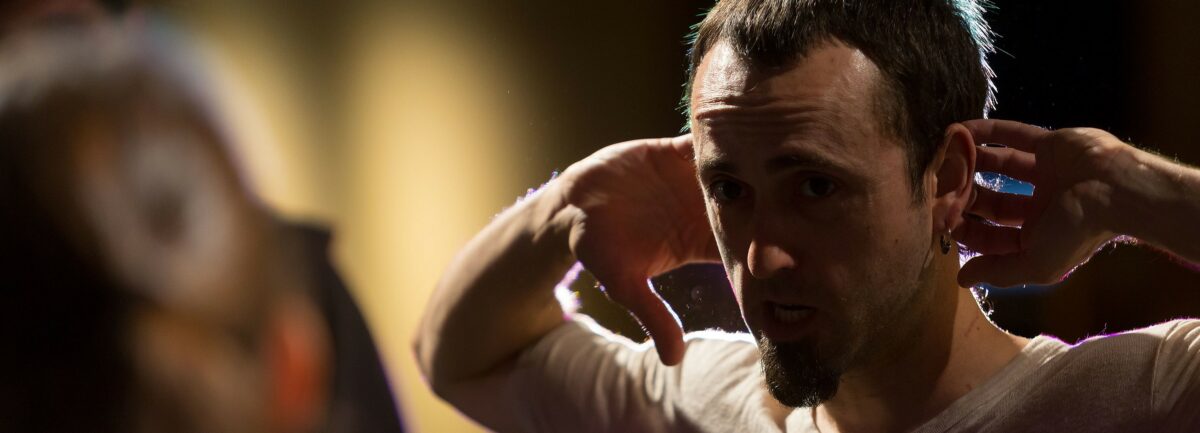
A puerta cerrada (Behind Closed Doors) takes the form of three artistic pieces in the shape of a trilogy. The first two, choreographic-audiovisual works in digital format, will premiere online on June 12 and 19. Both are being worked on during an artistic residency in the museum building itself between May 25 and June 1. The third part is a piece by Jon Maya that is expected to premiere at the museum on October 10. This show will open "Museo en Danza" (Museum in Dance) and will be an invitation to share live dance with the public.
The project as a whole is a creative process triggered by the crisis situation that engages in a dialogue with the architecture of the Museum and with David Jiménez's exhibition "Universos" (Universes), inspired by José Ortiz Echagüe's photographs of Roncalesas (1920), which belong to the Museum's collection.
The artists themselves and the museum's artistic directors will share their reflections with the public through three events, two of which will be digital, preceding each of the pieces in the trilogy, with the aim of exploring them individually and facilitating their understanding as part of a whole.
Access to the meetings:
- José Manuel Garrido and Jon Maya set the framework for the project.
- Jon Maya and David Jiménez, two artists facing the creative process
‘TODAY AND TOMORROW ARE YESTERDAY’ /‘BIHAR, ETZI, ATZO DA’
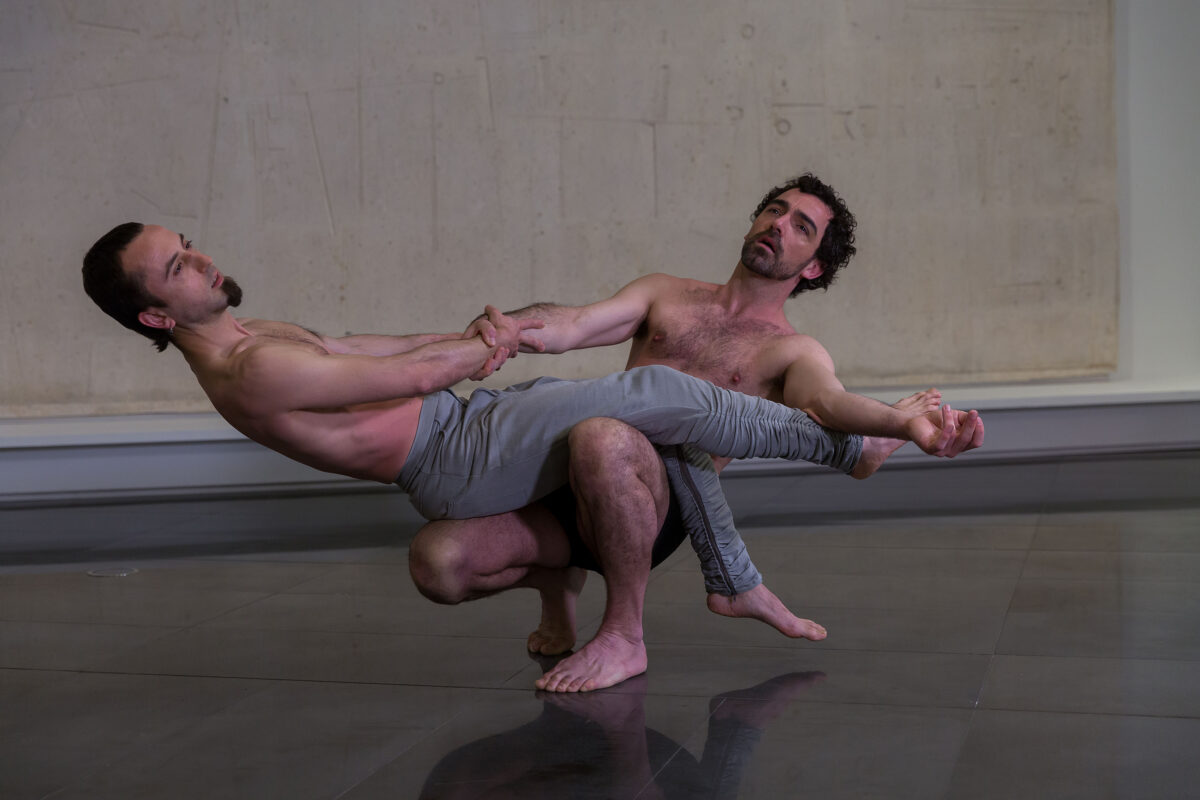
Ortiz Echagüe's photograph 'Las Roncalesas de 1920' serves as inspiration for choreographer Jon Maya in this piece. In it, three dancers personify the flu pandemic of the 20th century in an indoor confinement. Through his dance, the artist constructs a narrative that links the pandemic context of the era photographed with the present and the future we are heading towards. The unstoppable wheel of time invites us to revisit a past that builds a bridge to a new future. The music, by composer Luis Miguel Cobo, revolves around Bach, the artist who inspired Jorge Oteiza's famous 'Homenaje a Bach' (Homage to Bach), a piece from the collection located in the room where part of this choreography takes place.
Access to Today and Tomorrow are Yesterday
-
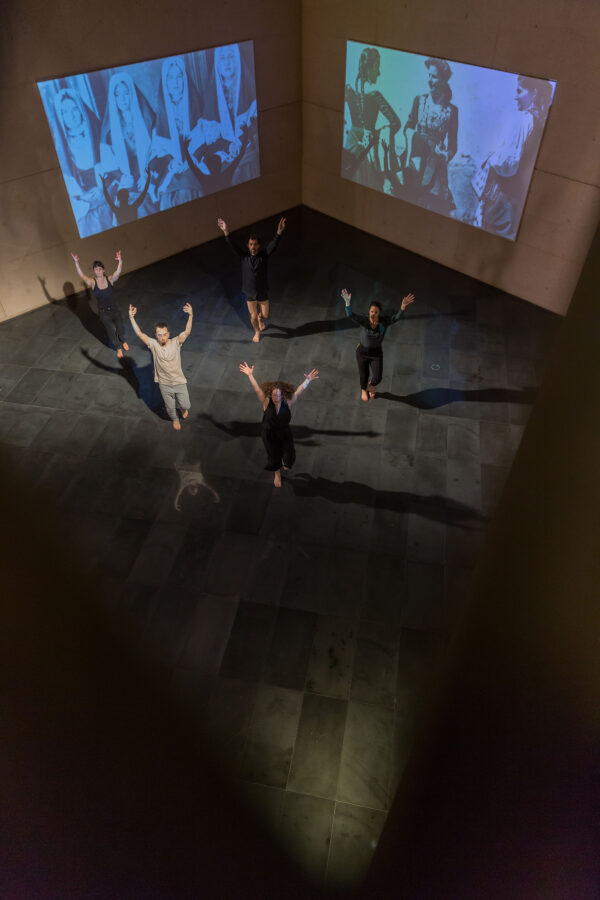
Dancers with Ortiz Echagüe's work in the background -
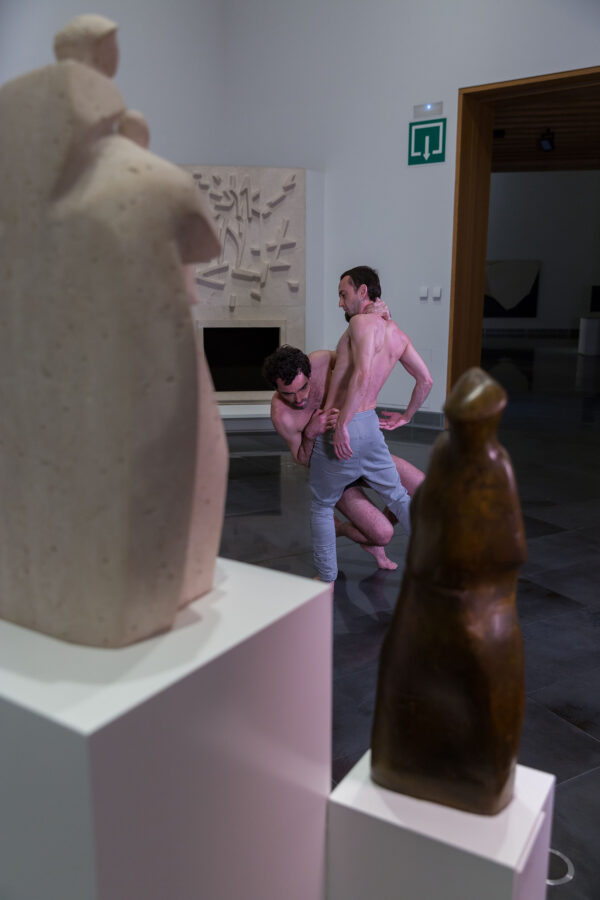
Dance in the Oteiza Room -
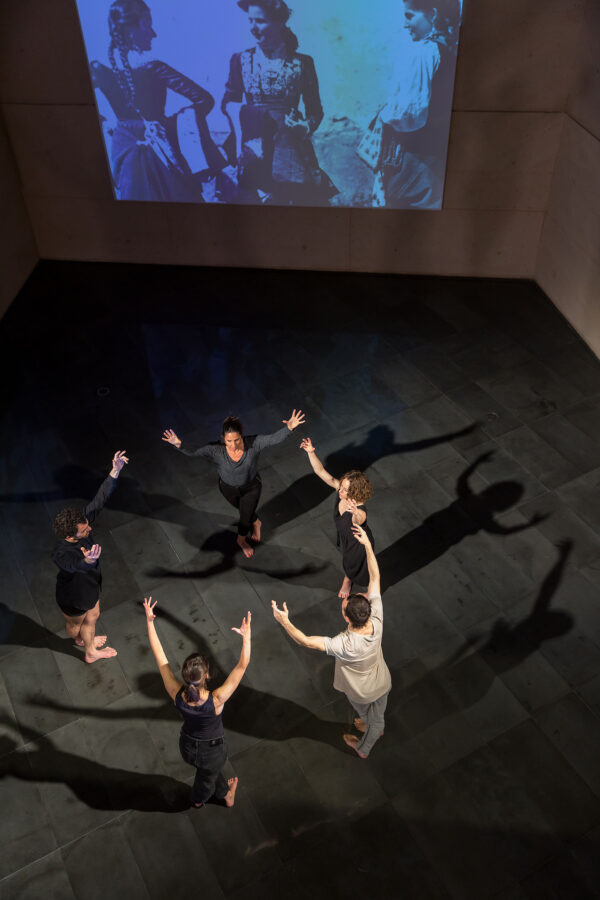
A moment in the choreographic-artistic process
‘SITUATIONS’ / ‘EGOERAK’
The current pandemic has highlighted with particular insistence the contrasts and concerns, the dualities that accompany human beings: interior/exterior, darkness/light, solitude/contact, balance/imbalance. The situations experienced by all people are translated into a movement that is in tune with the architecture of the building and the exhibition 'Universos' by photographer David Jiménez. A movement based on the contrast between light and dark, between the interior and exterior landscape, on the decontextualization of one's own experiences from the opening up to new, sometimes uncertain, situations.
Access to Situations
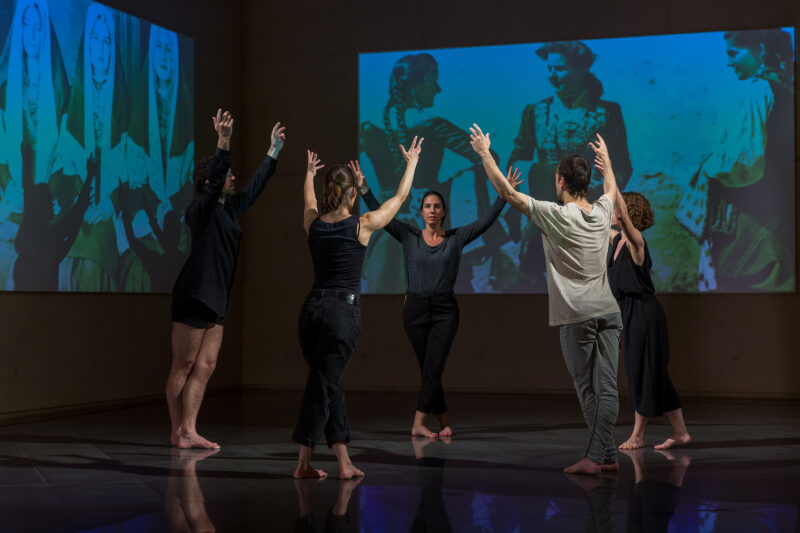
‘GAUEKOAK’: chronicle of a lockdown
Kukai Dantza's latest creation, 'Gauekoak', takes on new meaning and relevance in light of recent events. The piece reflects the creative confinement of an artist during his process of reflection and experimentation. With the night and an everyday space as their habitat, dancer Jon Maya and musicians Xabi Bandini and Arkaitz Miner confront the creator's confinement. They will perform live a piece that features Israel Galván, Cesc Gelabert, and Sharon Fridman as guest choreographers.
This activity, held on October 10, 2020, at the theater, opens the third edition of Museo en Danza, a series marked by thought, reflection, and the reunion of the public and creators in performance spaces. Through its different formats, "A puerta cerrada" leads us toward a new normal that will mark the live encounter between the public and creators.
Other materials:
Creation notebook. Jon Maya
Museum in Dance Cycle 2020
ANTONIO RUZ
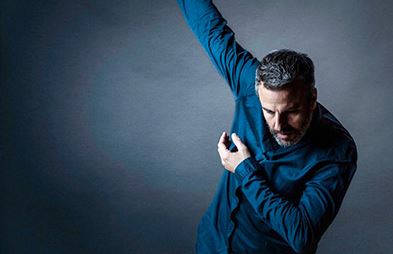
An independent choreographer and dancer, he is one of the most prominent creators in dance in our country. His discourse is based on a marked interest in the more open nature of dance. This openness is the result of both his extensive training and the development of his creative homily, framed within contemporary dance, but also within Spanish dance and flamenco, and the encounter between the two.
It was in 2009, as a result of a personal and artistic need, that Antonio Ruz created his own dance company in Madrid. "My challenge in each project is to bring out the human side of the performers, to reveal their personality. Technique and virtuosity without an underlying message do not interest me," explains the creator.
Among the mentions and awards that mark his career are the recent 2018 National Dance Award in the Creation Category and the 2013 RTVE "Ojo Crítico" Dance Award.
ARTISTIC RESIDENCY PROJECT
Taking as its starting point a selection of black-and-white photographs from the Museum's collection by various 20th-century artists, the work proposes an evocative interplay through dance in which the dancers engage in dialogue with the architecture, light, and music in different spaces of the Museum.
"For years, my passion for photography has made this art form an important creative tool as a choreographer; the main source of inspiration for some of my works. I have always been fascinated by the process of transforming a flat image into the three-dimensionality of the body in motion and the way in which this process connects the past and the present."
Antonio Ruz
Access to the video summary of the piece:
TRANSMUTATION 9/11/19 | 7:30 PM
Access to the video summary of the 2019 Museum in Dance cycle
2023: Publication of Antonio Ruz's Creation Notebook "Transmutation."
SOLILOQUIOS / ISIL- HIZKETAK began as a project in the fall of 2017 with an invitation from José Manuel Garrido, artistic director of performing arts and music at the University of Navarra Museum, to Jon Maya, director of Kukai Dantza, to participate in the artist accompaniment program during the creative process. The cross-cutting nature of artistic languages, art in motion, the connection with the university community, and the recording of these processes are some of the main elements of this program. In the work generated, the Museum acts as a source of inspiration, support, and channel for the birth of a living work.
Jon Maya collaborated on this project with Israel Galván and Cesc Gelabert, three creators with very diverse backgrounds and interests who made this artistic project a delight for the audience. All three emphasized that the richness of the collaboration had provided them with a wonderful learning experience thanks to their contact with the other creators, a very close bond with the audience, and the opportunity to integrate pieces of art closely linked to their own roots into their creation.
SOLILOQUIOS / ISIL- HIZKETAK premiered on May 23, 2019, at the University of Navarra Museum.
ITSASO A. CANO
Itsaso Álvarez Cano is the director of the company ZUK PERFORMING ARTS. She is a dancer and choreographer with a degree in Contemporary Choreography from the María de Ávila Conservatory of Dance. Itsaso is a multifaceted creator who directs and choreographs stage shows, musical concerts, choreography for film, dance videos, and music videos. Continuously learning and exploring, the choreographer integrates her knowledge into her work.
Zuk was founded in Madrid in 2012. The company stands out for its contemporary productions, which incorporate dance and the performing arts through music, audiovisuals, and direct contact with the audience, all combined with a unique choreographic language that arises from the encounter between urban dance and contemporary dance.
SUBJECT
"Cover your memory with the mask of who you will be,
and frighten the girl you once were"
- A. Pizarnik -
It is a disturbing journey that delves into our feelings and questions our behavior patterns, asserting that we are much more than skin and bones. It premiered on November 9, 2018, at 7:30 p.m.
The piece led to the publicationof Cuaderno de Creación (Creation Notebook) by Itsaso A. Cano.
ARTISTIC CREDITS
Direction and choreography: Itsaso Álvarez Cano
Musical composition: Sofía Comas, Guillermo Medín, and Gonzalo Rivas (electronic music)
Costumes and lighting: Eleni Chaidemenaki
Dancers: Julia Lith, Ada Continente, Macarena Bielski, Selene Martínez, Jhonder Gomez, and Marco Motta
Musical performance: Sofía Comas (singer)
Chorus of dancers and collaborators from Navarre: Laura Sola, Ana Gutierrez, Margarita Gómez, Ainhoa Yuantao, Amaia Martinez, Anna Emmanuel, Irune Vazquez, Goizeder Azcarate, Anne Mendoza, Amaia Arbeloa, Izai Rodriguez, Paula Casajús, Ivan Navarro, Sara Ariño, Raquel Ordoñez, Iranzu del Valle de Miguel, Harritxu de Atxa Cancel
Production: Miguel PG
Production Assistant: Vicente Romero
Photography and video: Harria Producciones
Other materials:
Video summary Museum in Dance, a series presenting Matter
Book: Creation Notebook
DANI PANNULLO
Dani Pannullo was born in Río Negro in Argentine Patagonia.Trained in dance and theater in Buenos Airesand afterlong periods of research in the US and Japan, he settled in Spain, where he has been living for more than twenty years, and it is in Madrid where he has developed his entire artistic career as a choreographer and stage director.
Hisinspiration has always been urban culture, to which he incorporates other dance forms he has encountered on his exploratory travels around the world, such as Japanese butoh, Egyptian dervish dancing, and flamenco, among others.
His company, created in 1999 with dancers from a wide variety of disciplines, has produced some twenty shows during its residencies at theCentro de Nuevos Creadores in Madridand theCentro de Danza Canal, participating in national and international festivals representing contemporary creation both inside and outside Spain. In2016, he gave an urban dance workshop at the Museumand brought his show Avalancheto the theater.
'ATLAS, MAP OF MOVES'
Dani Pannullo's creation is inspired by the travels of photographer José Ortiz Echagüe, who captured the landscapes, roots, and customs of the countries he visited with masterful scenographic composition. Panullo draws inspiration from Ortiz Echagüe's work to show viewers the beauty of the static through the movements of these new forms of expression.
ATLAS Map of Movestakes us on a journey through the new techniques of physical expression created by young people on the outskirts of cities around the world. Greco-Roman wrestling,freestyle workout,B-boying, andparkour featureacrobatics, movements of great physical skill, risk, and madness of great beauty that construct a contemporary urban ballet inspired by the work of Ortiz Echagüe.
These forms of physical expression originated on beaches, in parks, and on terraces around the world and have captivated many young people. For this reason, the show aims to build an urban discourse that unites those who practice these techniques on a daily basis and who, for various reasons—geographical, social, educational, etc.—find themselves isolated.
This piece premiered at the Museum on November 16, 2018, at 7:30 p.m. and gave rise to Danni Pannullo's Creation Notebook.
Other materials:
Video summary of the work in progress for the piece Atlas Map of Moves
Video presentation Museo en danza
Martín's residency at the University of Navarra Museum resulted in three works—Control, Symptoma, and Oximórica—and a constant stream of actions and reflective developments. The artist's sketches and notes, some of his key ideas and obsessions, were collected in the book Cuadernos de Creación (Creation Notebooks), the first volume in the collection of the same name. In it, readers can also explore the images, landscapes, and texts that inspire the author.
Galician choreographer and dancer Javier Martín premiered Control on February 20, 2015, after presenting a work in progress in November of the previous year.
Part of the Madrid International Dance Festival, the work was co-produced by the Museum and the consulting firm Artibus. As part of his artistic residency, the artist participated in a workshop and a conference on research into the performing arts.
With a scientific background and multiple conceptual interests, Martín presented this solo improvisation and subsequent debate as a shared experience.
In 'Control', he develops the concept of transformation to create a single piece, seeking to "discover how this psychic energy is structured in the body; to find out how this energy remains immobile, potential, pacing and changing the location of the constant movement of homeostasis, its inherent kinetics or biodynamics."
The self-taught and eclectic choreographer also gave a workshop entitled 'El cuerpo fantasma' (The Phantom Body) over the weekend, in collaboration with the University of Navarra.